

Generative engine optimization: how to optimize for GEO in 2026
Generative engine optimization is how brands get named inside AI-written answers. What GEO is, the five pillars of a GEO program, and where it parts company with classic SEO.


Generative engine optimization is how brands rank inside AI-written answers. When a customer searches for your services in 2026, they often see one authoritative AI-written answer at the top of the screen instead of a list of blue links. Fewer people click through: Pew Research Center found Google users clicked a regular result in 8% of visits with an AI summary, against 15% without one.
Knowing how to optimize for GEO is the new core competency. Old SEO fought for clicks. GEO fights for citations inside the model's synthesized answer. This guide is the 2026 GEO playbook: what generative engine optimization is, the four moves that change citation rate, and how to start running it across ChatGPT, Perplexity, Claude, and Gemini this week.
The GEO economy in 2026
What is GEO?
Generative Engine Optimization (GEO) is the work of writing and structuring content so generative AI engines, ChatGPT, Perplexity, Claude, Gemini, Microsoft Copilot, and Google's AI Overviews and AI Mode, pick your data when they write the answer.
Old SEO targeted the index. The crawler had to find your page and rank it. GEO targets synthesis. The LLM has to pick your data as a trusted source when it generates the answer.
Why classic SEO is no longer enough
AI answer engines use Retrieval-Augmented Generation (RAG). They retrieve live pages and write from them; Google says its AI features retrieve pages through its core ranking systems.
It also created a star economy. Each answer cites a limited set of sources.
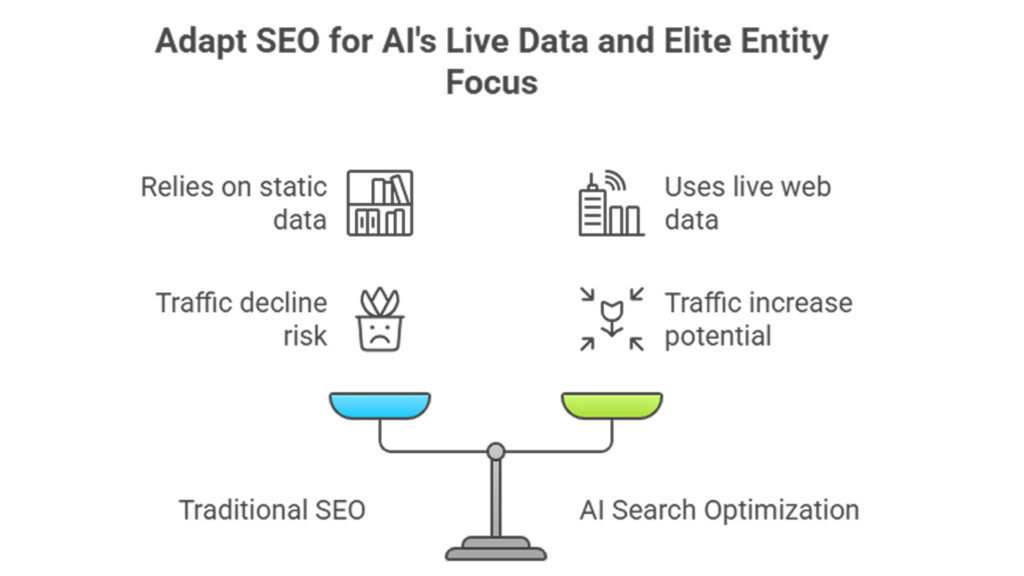
The image above shows the shift from classic search to AI-driven discovery. Static historical data on one side. Live web data and AI synthesis on the other.
GEO, AEO, and SEO: the new triangle
You will hear all three a lot. They are not competing. They stack.
- SEO is the foundation. It gets you indexed and crawled.
- AEO is the snippet game. Be the direct, quoted answer to a short factual query.
- GEO is the synthesis game. Be the trusted source the AI weaves into longer answers for complex prompts.
Webxhives runs them as one program. Most of the work is shared, schema, entity clarity, content structure, and citation tracking. Splitting them costs time and money. For the full breakdown of where each layer wins and what to ship first, see AEO vs GEO vs SEO: the 2026 search triangle.
How to optimize for GEO vs SEO: the entity comparison
| Dimension | Classic SEO | Generative Engine Optimization |
|---|---|---|
| Primary unit | A keyword | A complex multi-part prompt |
| Success signal | Rank position + click | Citation depth inside the synthesized answer |
| Page format that wins | Long-form list articles | Original data + Information Gain + entity-rich |
| Schema priority | BlogPosting + breadcrumb | Article + Organization + Entity references + Knowledge Graph |
| Authority signal | Backlinks | Cross-web brand mentions + reviews + original research |
| Measurement | Rank-tracking tools | AI Visibility Score per AI surface |
| Defensibility | Backlink moat | Entity reinforcement compound |
GEO does not require killing SEO. It requires re-grounding the same content discipline in entities and information gain instead of keywords and backlinks. The brands that win run both channels off one shared content engine.
The five pillars of a GEO strategy
I. Semantic depth over keyword density
AI processes concepts, not strings. Stop targeting "commercial insurance" alone. Build a semantic cocoon of expertise across the full topic graph: risk assessment, policy underwriting, historical claim data, and more.
II. Information gain and originality
Google asks for unique, first-hand content, not recycled summaries. Publish Information Gain, unique data, original case studies, or proprietary research the AI cannot find elsewhere.
III. Server-side rendering for crawlability
Many AI crawlers struggle with heavy JavaScript. Sites that lean on client-side rendering go invisible. Server-side rendering keeps the raw data ready for AI ingestion.
IV. Entity-first content
Queries are read by the engine as entities, people, places, products. Your content must explicitly tie your brand to trusted entities in the Knowledge Graph.
V. A reason to click
If the AI gives the summary, your page must offer what it cannot: a tool, a calculator, original data or a clear next step.
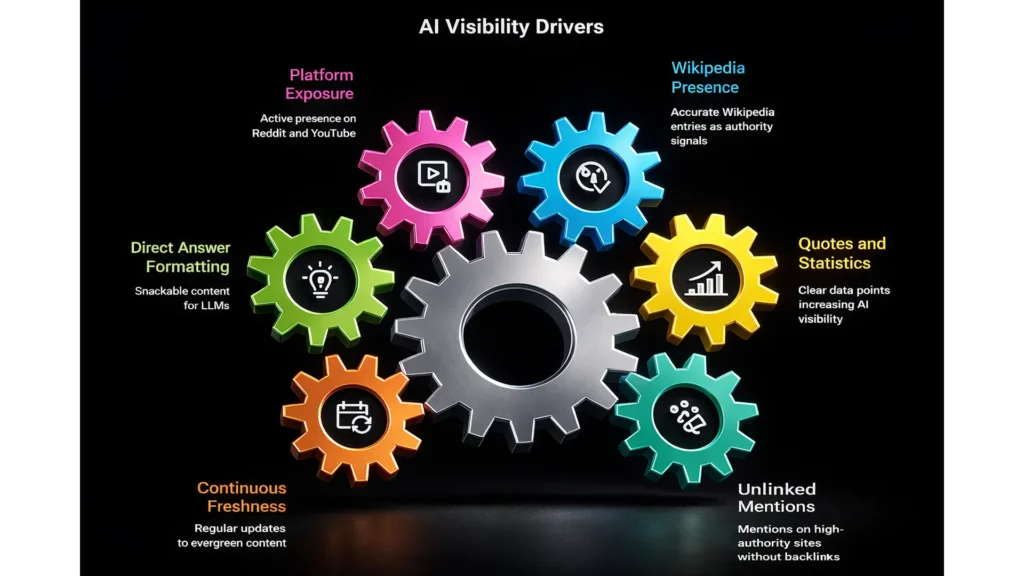
The six tactical drivers for AI visibility
These are the patterns research has surfaced for higher AI citation rates.
- Unlinked mentions. A plain-text brand mention on a high-authority site (news outlet, niche forum) carries weight even without a backlink.
- Quotes and statistics. In the 2024 GEO study, adding quotations, statistics and source citations raised visibility in generated answers by 30 to 40% on its test set.
- Wikipedia and Wikidata. They sit inside the primary training set for most LLMs. Accurate Wikipedia coverage is a major authority signal.
- Reddit and YouTube. AI now prioritizes human-generated discussion for real-world recommendations.
- Direct answer formatting. Open every section with a clean two-sentence definition. Use tables, FAQs, and bullet lists. Google says content need not be chunked for AI.
- Continuous freshness. AI prefers recent data. Updates to evergreen content are no longer optional.
Measuring GEO: the new KPIs
Start with the free reports: Search Console's Generative AI report and Bing's AI Performance report. For ChatGPT, Perplexity and Claude, add tooling that monitors:
- Share of Model (SOM). How often your brand is cited compared to competitors.
- Brand sentiment drift. Is the AI describing your services as positive, neutral, or worse?
- AI bot crawl frequency. GPTBot, OAI-SearchBot, ChatGPT-User, ClaudeBot, Claude-SearchBot, PerplexityBot and Perplexity-User, in your server logs.
The core of that tooling is a fixed prompt panel run across ChatGPT, Perplexity, Claude, Gemini, and Microsoft Copilot, logging every citation, miss, and competitor cited. You can run it by hand or with a third-party tool: Semrush, for example, ships an AI visibility toolkit that tracks brands across generative engines.
How to optimize for GEO: the seven-step playbook
If you only have time for one section in this post, it is this one. The order matters. Skipping step 1 means every later step compounds in the wrong direction.
-
Audit AI visibility first, not last. Before writing anything, measure where you stand. Run prompt tests across ChatGPT, Perplexity, Gemini, Claude, and Google AI Overviews. The quick version is to type 20 buyer-intent prompts into each engine and screenshot the answers. Log every miss and every wrong fact about your brand. For the technical side, run the free AI readiness check on your key pages.
-
Ship a Brand Hub. One canonical page on your domain (we run ours at /brand-hub) with structured, fact-dense content: legal name, founders, products, pricing, geographic coverage, official position statements. Plus a machine-readable llms.txt at the root (free generator here). AI engines parse this once and trust it for months.
-
Layer schema across your top 30 pages. Organization, Article, Product, Service, and entity-linked references to founders + locations + partners. Use Webxhives's free Schema JSON-LD builder. Validate every page in Google's Rich Results Test before shipping.
-
Rewrite headers in entity language. Replace keyword-stuffed H2s ("Best CRM software 2026") with entity-rich H2s ("What CRM do mid-market services firms use in 2026?"). The second matches how users now phrase prompts; the first does not.
-
Publish Information Gain content monthly. One piece of original research, proprietary data, or first-person operator perspective per month is the minimum to defend a topical authority signal. Rehashed listicles drag your entity score down.
-
Build cross-web authority deliberately. Unlinked mentions on news outlets, Reddit threads in your niche, Wikipedia entries, trade-journal quotes. AI engines verify brand truth using consensus across the open web. Backlinks help; mentions count even without them.
-
Track citations weekly and re-tune. GEO is not "publish and forget". Citation rates drift as AI models update (sometimes monthly). Keep the prompt panel fixed, log results by engine, and note which content change came before each move.
Conclusion
Search has moved from a list of blue links to a conversation. You are either the source the AI cites, or you are silent. Knowing how to optimize for GEO is the differentiator between brands AI engines recommend and brands AI engines ignore.
Decide per crawler: blocking GPTBot does not remove you from ChatGPT search, blocking OAI-SearchBot does, Google-Extended does not affect Search, and Search Console now has a separate opt-out for AI Overviews and AI Mode.
Two ways to start this week:
- Self-serve: run the free AI readiness check on your key pages, then run your own prompt panel using the playbook above.
- Done-for-you: Webxhives's AEO + GEO program runs the technical and strategic work end to end.
Frequently asked questions
1) What is generative engine optimization?
GEO is the work of shaping content so AI models like ChatGPT and Google Gemini retrieve, synthesize, and cite it accurately when answering users.
2) Is GEO different from AEO?
Yes, but they pair. GEO targets the synthesis layer, longer multi-source answers. AEO targets the snippet layer, direct quoted answers to short queries. Most of the work is shared, schema, entity clarity, content structure. Webxhives ships them as one program.
3) How does GEO improve SEO?
They compound. Semantic depth and structured data lift classic rankings and raise the odds of being featured in AI Overviews, the highest-visibility position on the SERP today.
4) How do I optimize content for generative engines?
Use a GEO framework with four ingredients:
- Structured data (JSON-LD).
- Question-and-answer formats that match natural conversation.
- High information gain through original research or data.
- Clear headings written in entity language.
5) How does GEO affect visibility inside ChatGPT?
ChatGPT search cites and links its sources, and OpenAI says sites that block OAI-SearchBot are not shown in its answers.
6) Does Webxhives track AI visibility?
Yes, as part of the AEO and GEO service: prompt tracking across your main buyer questions shows whether your brand, a competitor, or no one is being mentioned. For a quick technical check of a single page, use the free AI readiness check.
7) How do I generate more CTR in an AI-first world?
Write intent-led content. If the AI provides the summary, your page must provide the next step: a tool, a calculator, or a deep-dive whitepaper the AI cannot replicate. That is what pulls users out of the AI interface and onto your site.
8) Why does GEO matter for B2B lead generation in 2026?
B2B buyers treat AI assistants as digital sales reps. If your brand sits inside an AI-generated comparison of B2B software, you are in the consideration set. Miss it and the buyer never knows you exist.
9) How long does it take to see GEO results?
There is no reliable timeline; take a baseline on a fixed question panel, then re-run it on a schedule.
10) What is the difference between optimizing for GEO and optimizing for AI Overviews specifically?
Google AI Overviews is one of the surfaces GEO covers. Optimizing for AI Overviews starts with eligibility: indexed, snippet-eligible and not opted out in Search Console. Fan-out searches mean pages ranking for related queries can be cited. Full GEO covers all of that PLUS ChatGPT, Perplexity, Claude, and Gemini citations, which require entity reinforcement and cross-web authority beyond what Google alone rewards.
11) Should I build GEO in-house or hire an agency?
Both work. The measurement half (citation tracking on a fixed prompt panel, Brand Hub structuring) can run in-house by hand or with third-party tools. The consulting half (writing answer blocks, fixing entity graphs, building authority) takes regular weekly time from someone experienced. In-house if you have that headcount; otherwise the Webxhives AEO + GEO program runs it for you.
Key takeaways
- Decide per crawler: blocking GPTBot does not remove you from ChatGPT search, blocking OAI-SearchBot does, and Google-Extended does not affect Google Search.
- Measure with Search Console's Generative AI report, Bing's AI Performance report and a fixed prompt panel for the other engines.
- Publish first-hand, original content; Google asks for non-commodity content, not recycled summaries.
Questions people ask about this
Short answers to the questions that come up most on this topic.
- It is the base. Google says its AI features retrieve pages through its core Search ranking systems, and a page must be indexed, eligible for a snippet and not opted out in Search Console. Fewer people click, though: Pew Research Center found a click on a regular result in 8% of Google visits with an AI summary, against 15% without one. Other engines run their own crawlers, so allow OAI-SearchBot, Claude-SearchBot and PerplexityBot if you want to be cited.
Keep reading
Related articles.
More on the same thread, picked by tag and category, not chronology.

AEO 101: The Definitive Guide to Answer Engine Optimization in 2026
Answer engine optimization is how a brand gets cited inside ChatGPT, Perplexity, Claude, Gemini and Google AI Overviews. What AEO is, how it differs from SEO, and the playbook to run.
Muhammad Zeeshan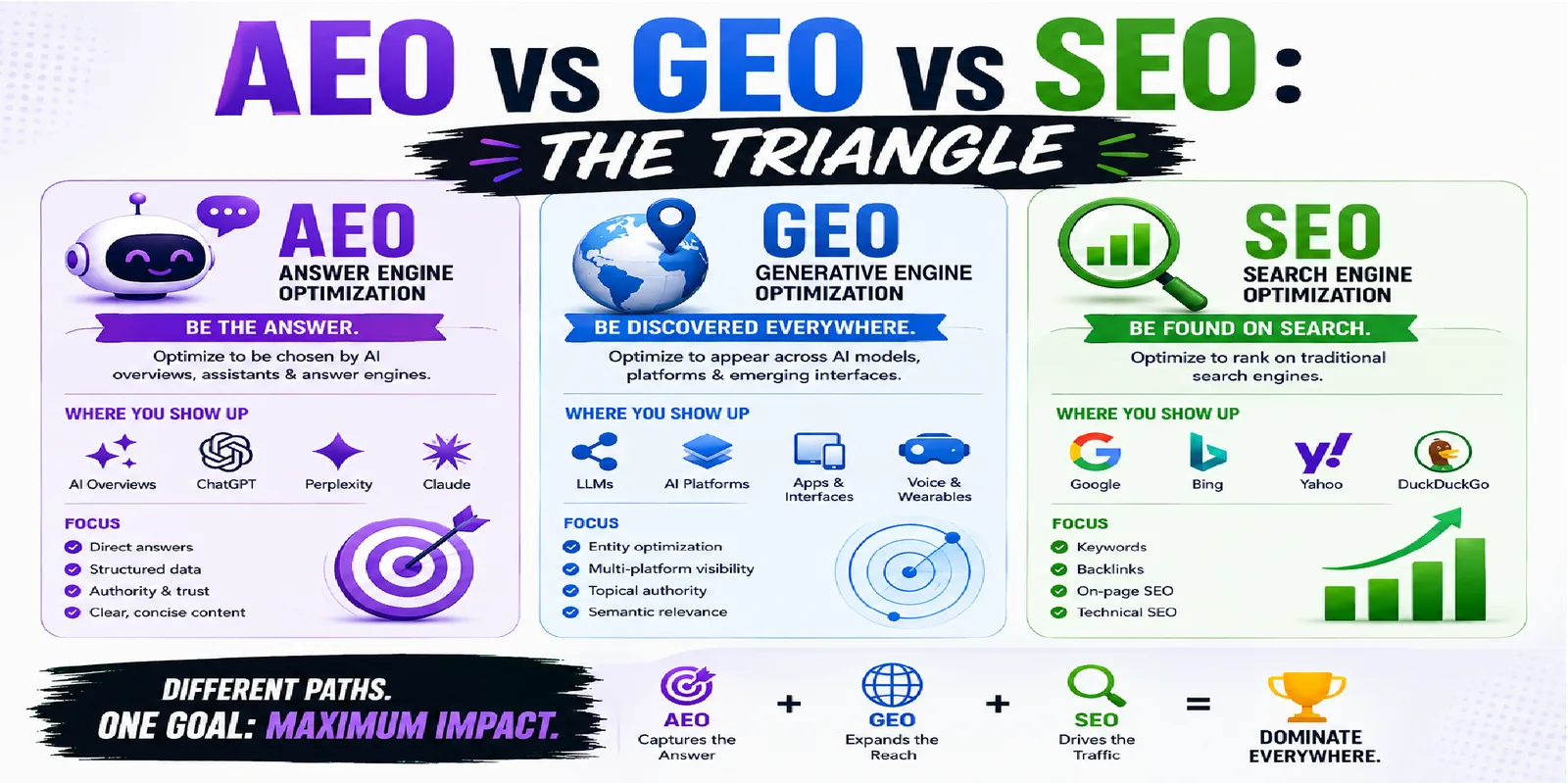
AEO vs GEO vs SEO: The Triangle
SEO is the foundation. AEO is the snippet game. GEO is the synthesis game. They are not competitors. Run them as one program and they compound.
Muhammad Zeeshan
Nested JSON-LD: Architecting Schema for GraphRAG & AI
Nested JSON-LD with @id anchoring is the 2026 standard for AI retrieval. Flat schema is now actively penalised by Perplexity and ChatGPT. The GraphRAG-ready architecture, and why explicit entity edges stop a brand-name collision.
Muhammad ZeeshanKeep exploring
From reading to doing.
See how we can help, look up a term, or check your own site with a free tool.
Put the guide to work.
Websites, Webflow, WordPress, Shopify, Framer, SEO, AEO and GEO, AI automation, and ongoing support.
See servicesPlain-language definitions.
SEO, AEO, GEO, website, and AI growth terms explained without the jargon.
Open the glossaryCheck and fix it yourself.
Free tools for SEO, AI search, and website planning, including an llms.txt generator and a schema builder.
Try the toolsReady when you are
Want help with AEO & GEO?
Send us your website and your goal. We will tell you honestly what should be done first, whether or not we work together.