

Gamified Onboarding for SaaS: How to Lift Activation 30-50 Percent
The implementation guide. Why gamified onboarding works (the boring research-backed part), the four mechanics that move SaaS activation, and the five-phase plan for designing the quest.
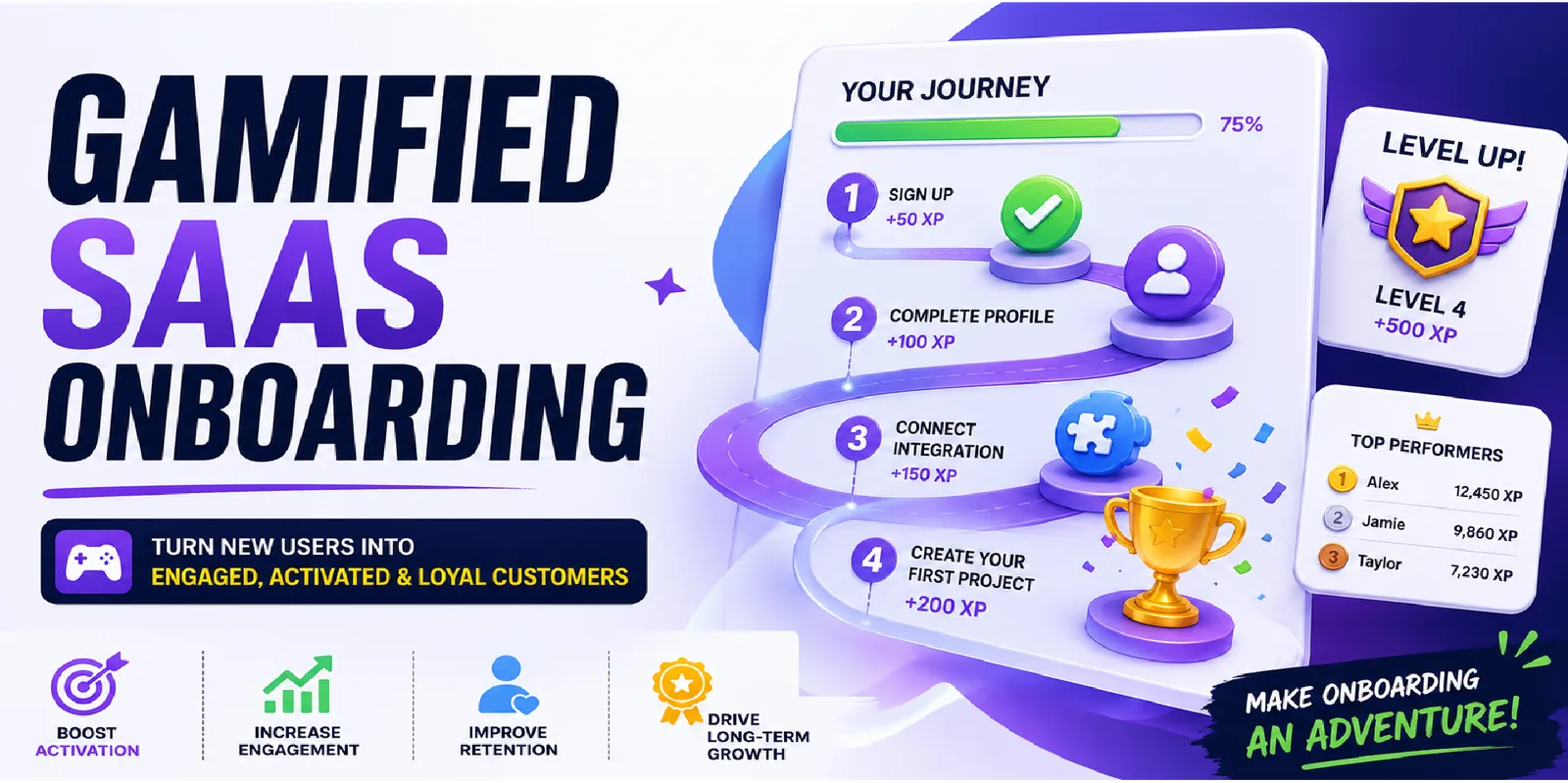
SaaS onboarding has a specific, well-measured failure mode: the user signs up, lands in the product, gets confused, and never returns. On many B2B SaaS products, only a minority of new signups ever reach their first meaningful action. The products with the strongest activation tend to run some form of gamified onboarding.
This is the implementation guide. Why it works, the four mechanics that move activation 30 to 50 percent, the design rules that separate working onboarding quests from busywork checklists, and a step-by-step plan for designing the quest.
The activation problem in 2026, in one chart
Three facts describe the modern SaaS activation funnel.
The 2026 SaaS activation funnel
If you only fix one part of the SaaS funnel, fix this one. Most of every paid acquisition dollar is lost before it reaches retention if only a quarter of trials activate. Doubling activation doubles the effective ROAS of the paid program without changing a single ad.
Why gamified onboarding works (the boring research-backed part)
Three psychological mechanisms drive the lift, all well-documented in product and game-design literature.
The endowed-progress effect. People are more likely to complete a goal when they perceive themselves as already started. A checklist that opens with the first item already checked (account created) lifts completion versus the same checklist with no items pre-checked. Joseph Nunes and Xavier Drèze documented this in 2006, the effect replicates consistently.
The Zeigarnik effect. Incomplete tasks occupy more cognitive bandwidth than completed tasks. A visible progress bar at 60 percent creates more urgency than no progress bar at all. Bluma Zeigarnik described this in 1927; the work survived the replication crisis intact.
Variable-ratio reinforcement. Predictable rewards get less interesting over time. Variable rewards (sometimes you get a small win, sometimes a bigger one, sometimes nothing) sustain attention longer. B.F. Skinner's research from the 1930s, refined by James Olds in the 1950s, is the basis of slot machines and most addictive game loops. Inside an onboarding quest, this looks like surprise rewards on milestone completion (an unlocked feature, an unexpected discount, a recognition badge).
The mechanics that work in onboarding combine all three. A checklist with pre-checked first items shows endowed progress. A visible bar fills toward an unfinished goal exploits Zeigarnik. Surprise rewards at milestones provide variable reinforcement. The combination is why the lift compounds; each mechanism on its own buys 5 to 10 percent, the combination buys 30 to 50.
The four mechanics that move SaaS activation
These four mechanics are the load-bearing parts of most working SaaS onboarding programs.
1. The first-week checklist with visible progress
A short, ordered list of actions a new user must complete to reach activation. Visible at all times in the product (sidebar widget, top bar, dedicated tab). Three to seven items, no more.
The rules that matter.
- Open with the first item already complete. Endowed progress kicks in.
- Each item maps to a measured activation milestone, not to a feature tour.
- Progress is shown as a percentage and a visible bar.
- The final item rewards a real benefit (extended trial, free credits, a real feature unlock).
Examples that ship well. Notion's setup checklist (the legendary 80 percent goal). Asana's first-task celebration moment. ClickUp's onboarding wizard.
The trap. Checklists that include items the user does not need ("connect your calendar", "invite a teammate") when the user signed up to do something else are noise. The list must reflect activation, not feature breadth.
2. The progress milestone with a meaningful reward
At specific points in the activation journey, the user crosses a milestone and earns something concrete. Not a badge for the trophy cabinet, a benefit they can use.
What earns its keep. Free credits to keep using the product. An unlocked premium feature for 30 days. A direct line to a customer success manager who will help finish setup. A trial extension. A free month of the paid tier upon hitting the activation milestone.
The trap. Symbolic rewards (a badge, a digital sticker, a "level 2 user" title) move the activation needle by approximately zero in B2B contexts. Save symbolic rewards for community and loyalty, where social proof drives the value.
3. Buddy and team challenges
Onboarding accelerates dramatically when the user invites a teammate. The teammate validates the value, the original user has someone to compare progress with, and the team account is now stickier.
What works. A "Refer a teammate, both get a paid month free" mechanic surfaced inside the onboarding quest at the right moment (usually after the user completes their first solo workflow). Best paired with a progress bar that fills faster as more teammates join.
Examples. Slack's "invite your team to keep going". Linear's first-week team-add prompt. Notion's workspace-level setup that nudges the workspace owner to invite the first three members.
The trap. Forcing the team-invite as the first onboarding step before the user has experienced value themselves. Premature invites convert worse than well-timed invites by a factor of 4 to 6.
4. Time-bounded "first wins" with countdown framing
Activate in your first 7 days and unlock X. Counter visible at all times. Loss aversion drives faster activation than reward seeking, the deadline shifts the psychology.
Best uses. Trial conversion ("activate in 14 days to keep your data when the trial ends"), upgrade nudges, season-of-year campaigns.
The trap. Fake urgency that resets after the user misses the deadline. Users notice within one cycle. The deadline must mean something real.
How to design the quest, step by step
Build the program in five phases. The dependencies matter; skipping any phase produces the broken version of the program.
Phase 1: Find the activation milestone. Pull the event data on retained vs churned users. Identify the 1 to 3 actions that correlate with retention. This is the milestone the quest aims at, not "users who use the product". Two weeks.
Phase 2: Reverse-engineer the path. Map every action a user must take to hit the milestone. Cull anything optional. The remaining list is the quest. Three to seven items. One week.
Phase 3: Design the surface. Decide where the quest lives (sidebar widget, top bar, dedicated tab). Decide what progress looks like (bar, ring, checklist). Decide the reward economy (real rewards at the 50, 80, 100 percent marks). One week, in collaboration with the design team.
Phase 4: Build and instrument. Engineer the quest into the product. Wire every interaction to the event store. Server-side attribution to the original acquisition channel. Three to five weeks depending on stack.
Phase 5: Tune. A/B test reward sizes, milestone copy, and reward types weekly for the first 8 to 12 weeks. The first version is rarely the converting version. Continuous tuning is what produces the 30 to 50 percent lift; the launch-day version usually buys 10 to 15 percent on its own.
Common SaaS gamification anti-patterns
These are the broken patterns that show up most often. Each one is fixable, but the fix usually requires acknowledging the original program shipped without measuring.
The vanity badge wall. A page in the user profile showing badges earned. Looks great in design reviews. Moves activation by approximately zero. Save badges for community, not onboarding.
The progress bar that fills then empties. Once the user hits 100 percent, the bar disappears and a new one starts. The reward for finishing is more work. Users notice. Make the 100 percent moment feel like an ending, not the beginning of a new task.
The streak the user did not sign up for. Some products try to attach a streak to actions the user does once a week. The result is a streak that breaks every Wednesday because nobody opens the product on weekends. Streaks only work when the underlying behaviour is genuinely daily.
The teammate invite prompt at minute one. "Invite your team to get started" before the user has done anything alone. The signed-up user has not validated the product yet, so they have no story to tell. The invite converts at a fraction of the rate it would after the user's first solo win.
The reward that is not actually a reward. "Complete onboarding to unlock the dashboard." The dashboard is the product. Locking the product behind onboarding is not a reward, it is a paywall. Real rewards are extended trials, free credits, premium features, or human help.
Where activation actually breaks
The pattern repeats across trial-led products. A visitor converts on the signup form, starts a trial, and then stalls somewhere before the moment the product becomes obviously useful. Every step after signup is a place to lose them, and the loss is concentrated in the first session.
Gamified onboarding works on exactly that gap: visible progress, one clear next step, and a reason to return tomorrow rather than a fourteen-day silence.
How this connects to the broader gamification playbook
Gamified onboarding is one of seven mechanics in the 2026 gamification marketing playbook. It pairs cleanly with two-sided referral mechanics (the buddy invite is itself a referral), with tier programs (the post-onboarding ladder), and with email engagement (the progress reminder is an email category).
For the broader category map, including spin-wheels, lead quizzes, and learning sims, see the pillar above. For a deeper dive into lead-magnet mechanics, see Quizzes, spin wheels, and scratch cards: the lead magnet mechanics that outperform forms 4x. For the engineering side of why most teams cannot ship this themselves, see the infrastructure section of the Temu growth strategy case study.
Frequently asked questions
1) How long does a gamified onboarding quest take to build?
It depends on the stack. Budget a few weeks from brief to live mechanic, plus extra time if your event store does not exist yet (Cloudflare Workers + Durable Objects, or Redis on your existing infra are the typical patterns).
2) Will the gamified onboarding cannibalise our paid trial conversion?
It rarely does. When the quest aims at the real activation milestone, trial-to-activated usually lifts and trial-to-paid holds steady or improves. The mechanism is selection: gamified onboarding gets fence-sitters off the fence faster, but it does not push unqualified users into a paid plan they would not have bought.
3) What if our product does not have natural milestones?
Then your retention is probably weaker than the public benchmarks suggest, and you have a product problem, not an onboarding problem. Onboarding gamification compounds existing product strength; it does not invent product-market fit.
4) Can the onboarding quest run without changing our app?
For some stacks, yes (the quest is a sidebar widget that reads from your existing event stream). For others, no (the milestone unlocks real product features, which requires a small product change). Map your milestones first to see which path your app needs.
5) How does this overlap with our customer success or onboarding email program?
It compounds with both. CSMs spot the right moments to step in (the user stuck at 60 percent on the bar). The email program triggers based on quest progress, not generic Day-3 / Day-7 templates. The whole onboarding system gets sharper.
6) Will users find this gimmicky in B2B?
Not if it is designed for B2B. The visual language for B2B onboarding quests is closer to "professional progress tracker" than "video game". The mechanics are identical, the visuals match the buyer.
Key takeaways
- The activation milestone is the single product action that correlates with 30-day retention. Find it via logistic regression before designing the quest.
- Visible-progress checklists with a pre-checked first item exploit the endowed-progress effect, lifting completion.
- Symbolic rewards (badges, titles) move the activation needle by approximately zero in B2B. Real rewards (extended trials, free credits, premium features) move the number.
- Premature teammate-invite prompts convert 4 to 6 times worse than well-timed invites placed after the user's first solo win.
Questions people ask about this
Short answers to the questions that come up most on this topic.
- It depends on the stack. Budget a few weeks from brief to live mechanic, plus extra time if your event store does not exist yet. Common patterns are Cloudflare Workers + Durable Objects, or Redis on your existing infra.
- It rarely does. When the quest aims at the real activation milestone, trial-to-activated usually lifts and trial-to-paid holds steady or improves. The mechanism is selection: gamified onboarding gets fence-sitters off the fence faster, but it does not push unqualified users into a paid plan they would not have bought.
- Then your retention is probably weaker than the public benchmarks suggest, and you have a product problem, not an onboarding problem. Onboarding gamification compounds existing product strength, it does not invent product-market fit.
- For some stacks, yes (the quest is a sidebar widget that reads from your existing event stream). For others, no (the milestone unlocks real product features, which requires a small product change). Map your milestones first to see which path your app needs.
- Not if it is designed for B2B. The visual language for B2B onboarding quests is closer to a professional progress tracker than a video game. The mechanics are identical, the visuals match the buyer.
Keep reading
Related articles.
More on the same thread, picked by tag and category, not chronology.
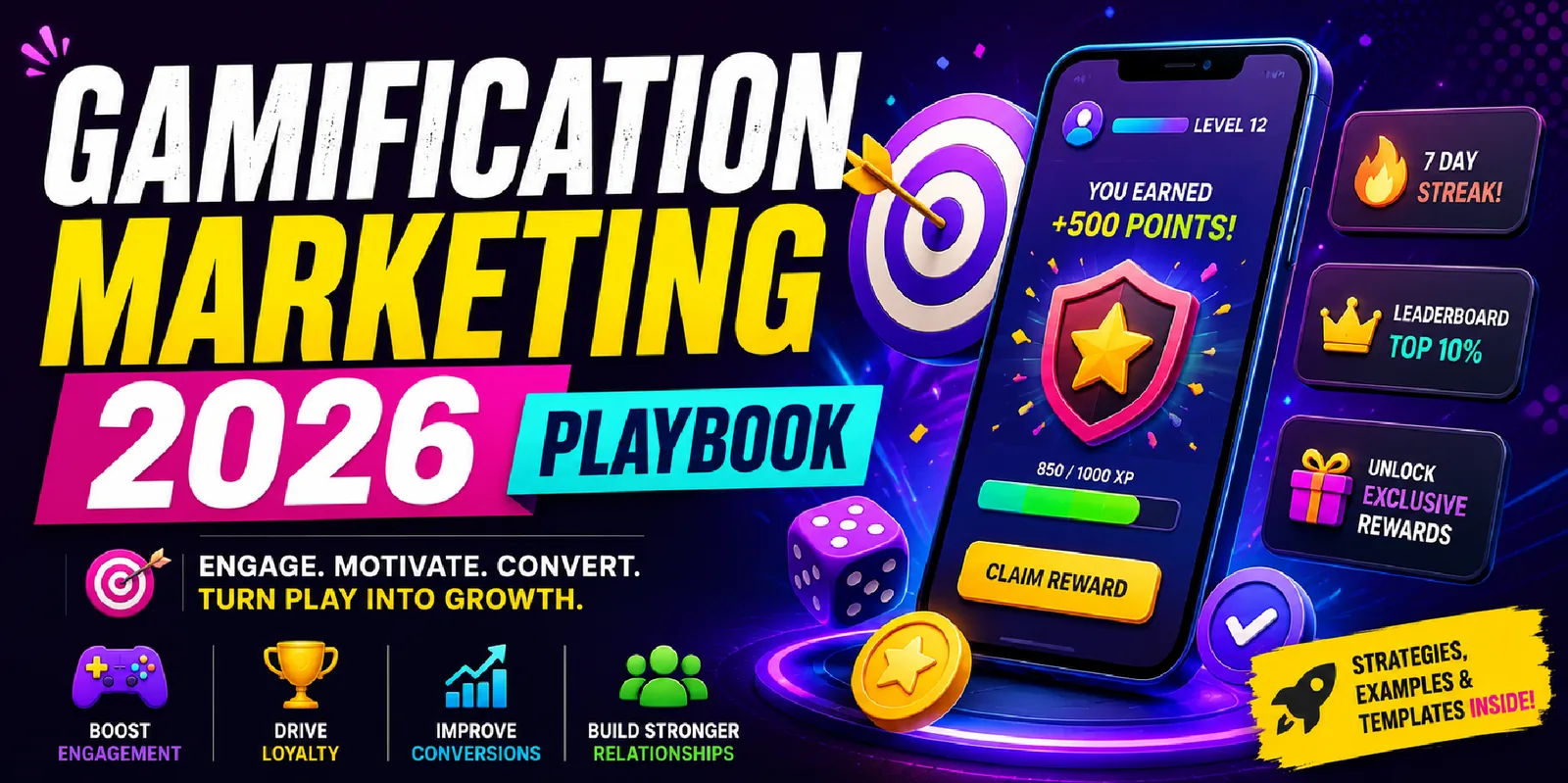
Gamification Marketing 2026 Playbook
Seven gamification mechanics that move real marketing KPIs in 2026. Quizzes, spin wheels, streaks, tier programs, onboarding quests, two-sided referrals, and learning sims.
Muhammad Zeeshan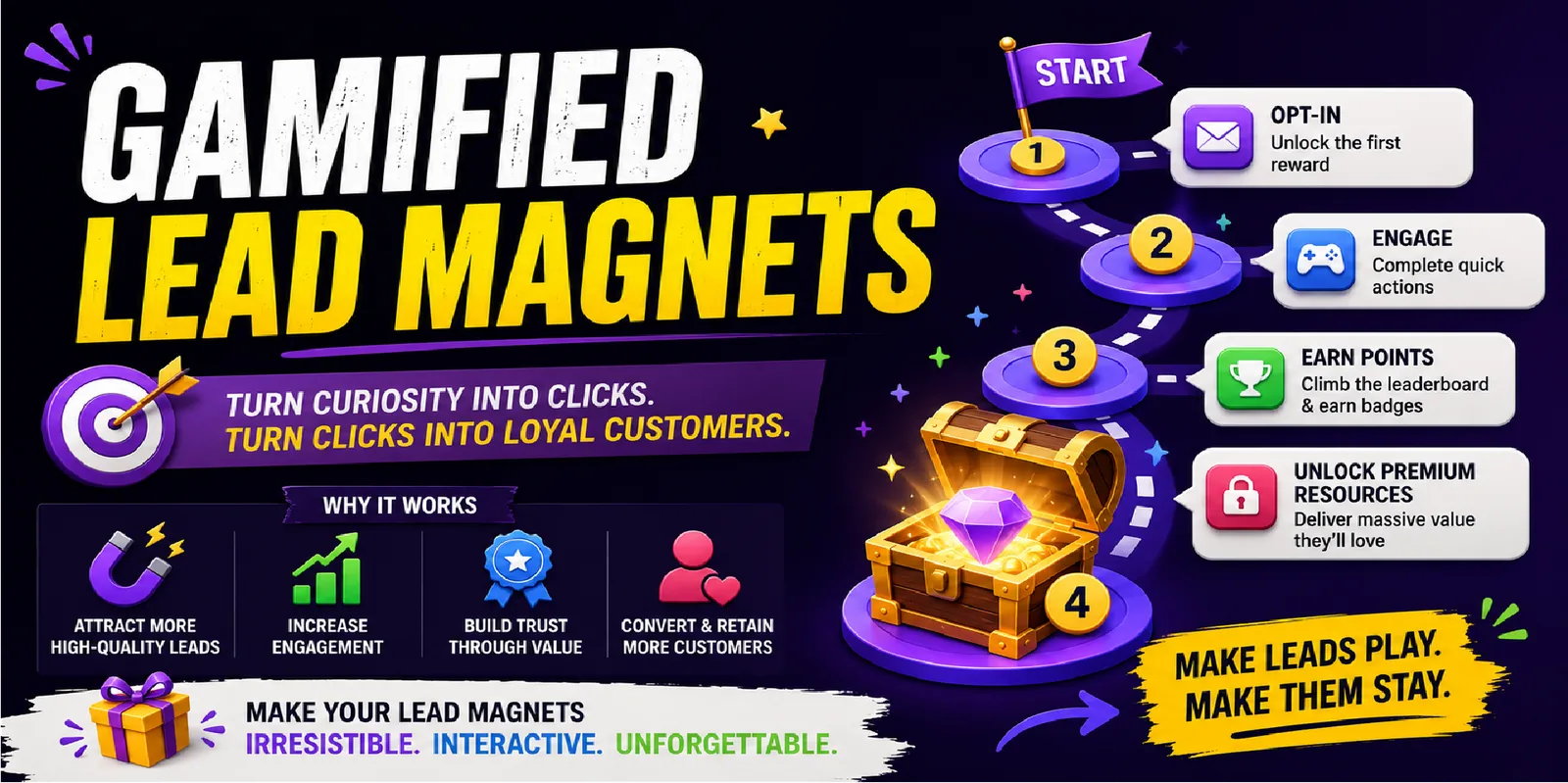
Gamified Lead Magnets
Static forms convert at 2 to 4 percent on cold traffic. Quizzes, spin wheels, and scratch reveals convert at 12 to 38 percent. The short, sharable version: when each mechanic wins, when it loses, and the reward economy that determines lead quality.
Muhammad Zeeshan
How Temu Used Gamification, Referral & Paid Ads to Explode in a New Market
How Temu grew with in-app games, referral rewards and heavy paid ads, what changed after US duty-free imports ended in May 2025, and what is still safe to copy.
Muhammad ZeeshanKeep exploring
From reading to doing.
See how we can help, look up a term, or check your own site with a free tool.
Put the guide to work.
Websites, Webflow, WordPress, Shopify, Framer, SEO, AEO and GEO, AI automation, and ongoing support.
See servicesPlain-language definitions.
SEO, AEO, GEO, website, and AI growth terms explained without the jargon.
Open the glossaryCheck and fix it yourself.
Free tools for SEO, AI search, and website planning, including an llms.txt generator and a schema builder.
Try the toolsReady when you are
Want help with Digital Marketing?
Send us your website and your goal. We will tell you honestly what should be done first, whether or not we work together.