

Gamification Marketing 2026: The Playbook That Books Demos and Sells Products
Seven gamification mechanics that move real marketing KPIs in 2026. Quizzes, spin wheels, streaks, tier programs, onboarding quests, two-sided referrals, and learning sims.

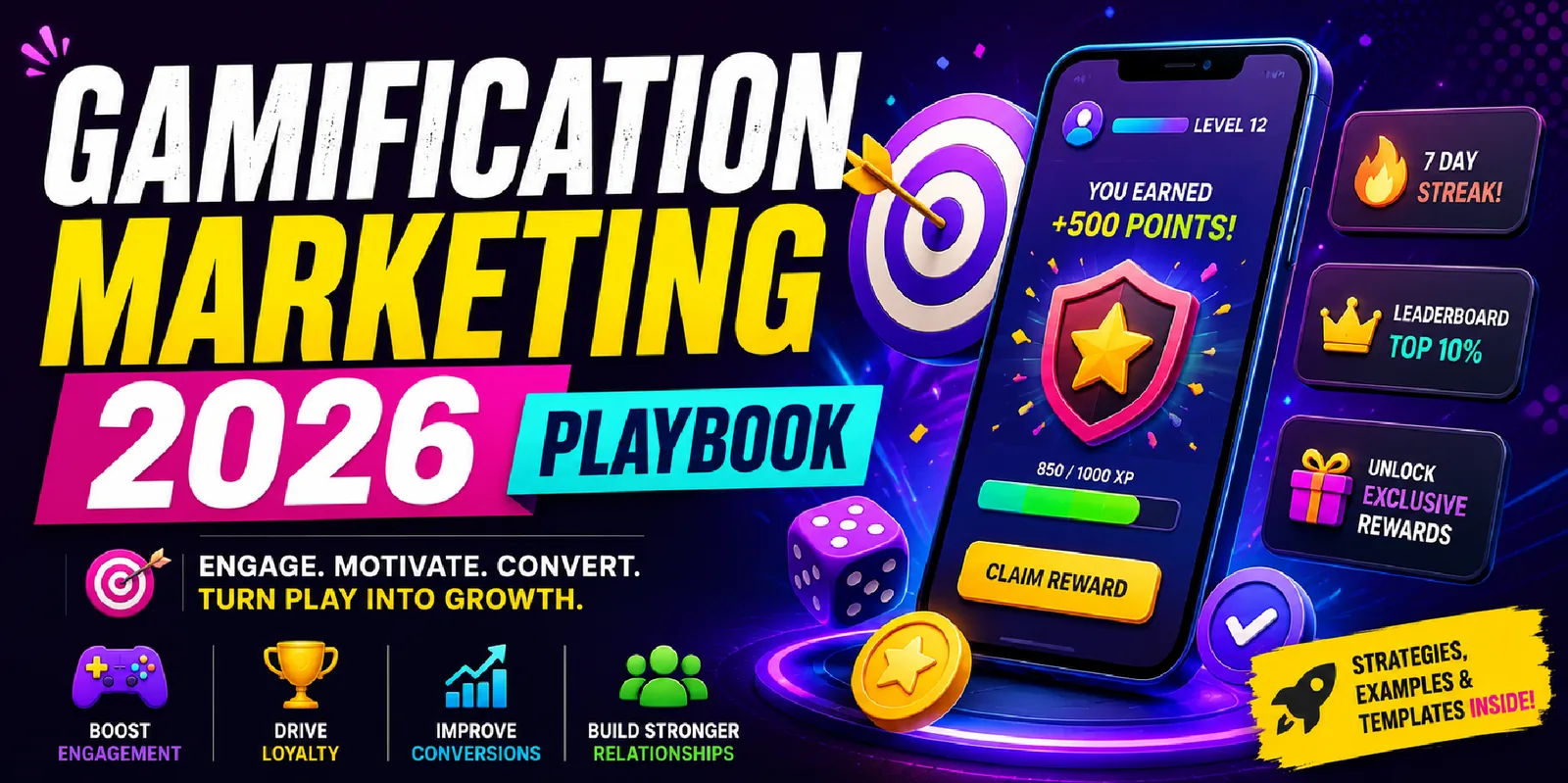
Marketing leads have run out of cheap conversion levers. The form converts at 2 to 4 percent. The webinar opt-in sits at 11. The seven-step nurture has the same open rate it had in 2018, just on a smaller list. The ad costs four times what it cost five years ago. There is one mechanic still capable of doubling those numbers without doubling the budget, and most B2B teams still treat it as a stunt: gamification.
This is the 2026 playbook. Seven mechanics that move real KPIs, the rules for picking the one that fits your funnel, the engineering and creative-pipeline gotchas that sink most rollouts, and how to measure whether a program is working.
Why marketing teams are revisiting gamification in 2026
What gamification is, and what it is not
Gamification is the use of game mechanics, points, levels, streaks, quests, leaderboards, randomised rewards, inside non-game products and funnels to drive a specific behavior. The literature has been around since Nick Pelling coined the term in 2002 and Yu-kai Chou's Actionable Gamification gave it a serious framework in 2014. The mechanics are not new.
What is new in 2026 is the combination of three things: shipping infrastructure has caught up (sub-100ms event stores on the edge are commodity), AI-driven copy and reward tuning makes the post-launch operations layer tractable, and the alternative levers for marketing teams have stopped scaling.
Gamification is not putting a confetti animation on the checkout page. It is not a one-off spin-the-wheel widget. It is a designed reward loop with a measurable KPI, wired into the surfaces your audience already uses.
What changed in 2026 marketing, and why gamification compounds now
Three forces are pushing gamification back to the top of the marketing stack.
Forms have hit a floor. Lead-magnet conversion on cold traffic plateaued at roughly 2.5 percent across B2B SaaS in 2024 and has not budged since. The marginal email costs more to acquire every quarter. Quizzes and segmenting funnels routinely beat that floor by 4 to 8 times, at the same paid CAC.
AI Mode keeps the click on the answer page. As we covered in the 2026 Google algorithm field guide, top-three pages now lose roughly 40 percent of their expected click flow when they are not cited inside AI Mode. The clicks that do arrive are higher-intent. Engagement mechanics that convert higher-intent clicks pay back faster.
Attention has fragmented past the point of nurture-only growth. The user who opens your email in 2026 will not click through to a 1500-word landing page and a four-field form. They will scroll back to TikTok. A 90-second quiz that returns a personalised result keeps them.
In most published comparisons, gamified surfaces convert higher than their static equivalents. That is not a universal law, so treat it as a hypothesis to test against your own baseline.
Seven gamification mechanics that move marketing KPIs in 2026
Across published deployments and benchmarks, seven mechanics consistently move real numbers. The rest are flavour.
1. The segmenting quiz funnel
A 6 to 10 question quiz that segments visitors and returns a personalised recommendation. The quiz captures the email at the result step, not before, and the personalisation is the payoff for completing it.
Best for. Lead generation on cold traffic, e-commerce product discovery, B2B product matching, financial services qualification.
Expected lift. 4 to 8 times the conversion of a static lead-capture form on the same traffic, with better lead quality because the quiz pre-segments.
Examples that work. HubSpot's website grader. Sephora's beauty IQ. Casper's mattress quiz. Warby Parker's home try-on quiz. Each one earns the email by giving back something the form could not.
The trap. A quiz that just asks demographic questions and emails you a generic PDF underperforms a form. The result has to feel earned and personalised, or the quiz is just a long opt-in.
We covered this in depth in Quizzes, spin wheels, and scratch cards: the lead magnet mechanics that outperform forms 4x.
2. Spin-the-wheel and reveal mechanics
A wheel, a scratch card, or a mystery-box reveal tied to email capture. The user enters an email, gets a spin, and the spin lands on something with real value (often a discount tier, sometimes a free product, sometimes a content unlock).
Best for. E-commerce email capture, event registration, exit-intent recovery on shopping carts, pop-up replacement for high-traffic blogs.
Expected lift. 2 to 5 times the conversion of a static email pop-up. Best results come when the wheel slots are weighted toward "small win" outcomes, big wins are rare but visible.
Examples that work. Shein's daily spin wheel, the Fenty Beauty mystery scratch card, Gymshark's Black Friday wheel.
The trap. A wheel that hands out the same 10 percent off code to every spin is a popup with extra steps. Users notice within two visits. Real reward variance and visible scarcity are what make the mechanic work.
3. Streaks and daily-login loops
Visible counters that reward consecutive days of engagement. Lose the streak and the counter resets. Hit a milestone (7, 30, 100, 365) and unlock a meaningful reward.
Best for. Daily-use products, learning apps, fitness, B2B products with a daily activation goal (CRM logins, task tools, dashboards), email engagement programs.
Expected lift. 15 to 30 percent improvement in D7 retention. The bigger lift is on D30: streak-protected users have 3 to 5 times higher 30-day retention than non-streak cohorts.
Examples that work. Duolingo (the canonical case, 365-day streaks now have public ceremonies). Snapchat streaks. Strava workout streaks. Apple's activity rings.
The trap. Streaks only work if the underlying product earns daily use. Slapping a streak on a quarterly-billing SaaS does not invent daily use. Pick a different mechanic.
4. Tier and points programs
Earn points for behaviours that move revenue. Tiers unlock real benefits. The progress between tiers is visible at all times.
Best for. Loyalty programs, repeat-purchase e-commerce, paid-tier upgrades, partner and channel programs.
Expected lift. 20 to 45 percent increase in repeat purchase rate. Best results when tier benefits are functional (early access, free shipping, exclusive items), not symbolic (badge, title).
Examples that work. Sephora Beauty Insider, Starbucks Stars, Ulta Ultimate Rewards, Amazon Prime tier benefits.
The trap. Points programs that earn nothing the customer values are an accounting overhead, not a marketing program. Test the rewards in user research before launching.
5. Onboarding quests and progress checklists
A first-week checklist with visible progress and milestone rewards. Each step unlocks the next.
Best for. SaaS activation, app onboarding, complex product onboarding, new-customer success programs.
Expected lift. 30 to 50 percent improvement in activation rate, 25 percent reduction in time-to-first-value.
Examples that work. Notion's setup checklist (the Aha! moment is reaching 80 percent on the bar). Asana's first-task celebration. Slack's onboarding bot Slackbot.
The trap. A checklist that includes steps the user does not need to succeed is busywork. The list has to map to real activation milestones, validated against retention data.
We dive deep on this one in Gamified onboarding for SaaS: how to lift activation 30-50 percent.
6. Referral mechanics with two-sided rewards
Refer a friend, both sides get something. The reward must be useful enough on its own to justify the share, and the share has to be one tap.
Best for. Apps with a network effect, marketplaces, financial services, anywhere a friend's experience materially improves yours.
Expected lift. 10 to 30 percent of acquisition from referrals on apps that ship the mechanic well. Compounds over time as referred users refer.
Examples that work. Robinhood (free stock for both sides), Dropbox (free storage for both sides), the Temu referral combo we documented in the Temu growth strategy case study, Cash App's $5-for-$5 mechanic.
The trap. One-sided referral programs ("get $20 when your friend signs up") underperform two-sided programs by 4 to 6 times. Pay both sides.
7. Branching scenario and learning sims
Interactive scenarios that branch on user choice, rewarding correct decisions and explaining wrong ones. The user practises the skill rather than reading about it.
Best for. Corporate L&D, sales enablement, compliance training, certification programs, security and phishing training.
Expected lift. 30 to 50 percent reduction in training time at equal or better knowledge retention. 2 to 3 times the engagement vs slide-deck training.
Examples that work. Salesforce Trailhead, KnowBe4 phishing sims, EdApp microlearning, Axonify's scenario engine.
The trap. A multiple-choice quiz dressed as a scenario is still a quiz. Real branching, with consequences that change the next scene, is what makes the mechanic work.
Corporate learning gamification is the clearest test of this category: done properly it cuts training time by roughly 40% without cutting retention.
How to pick the mechanic that fits your KPI
Start with a four-question filter. The answers narrow the mechanic to the two or three candidates worth testing.
- What single number are you trying to move? Activation, lead capture, AOV, D7 retention, certification pass-rate. One number.
- Who plays the game? Cold visitors, new users, existing customers, employees. The audience constrains the mechanic more than the KPI.
- How often do you need them to come back? Once is the lead-magnet game. A handful of times is the onboarding quest. Daily for months is the loyalty loop.
- What is the realistic reward you can hand out? Discounts, content, social status, real money, time saved. Mechanics break when the reward is less valuable than the work to earn it.
A mid-market B2B SaaS with a free trial activation problem has a different answer than a DTC fashion brand with a repeat-purchase problem. Same playbook, different mechanics.
Mechanic-to-KPI fit, the working table
| Best mechanic | Backup mechanic | |
|---|---|---|
| Lead capture from cold traffic | Quiz funnel | Spin-wheel reveal |
| SaaS activation in week one | Onboarding quest | Buddy challenge |
| D7 / D30 retention on a daily app | Streak | Tier program |
| Repeat purchase / loyalty | Tier program | Points + perks |
| Referral acquisition | Two-sided reward | Group-buy unlock |
| Compliance training time | Branching sim | Spaced-repetition cards |
| Sales enablement | Leaderboard + sim | Certification track |
| FMCG on-pack engagement | AR scavenger hunt | QR scratch card |
The infrastructure that separates working programs from launch-week stunts
The mechanics are public knowledge. The execution is where most rollouts collapse. Three failure modes account for the majority of broken gamification programs.
Latency. A spin-the-wheel that takes two seconds to land feels rigged. A streak counter that updates after the user has already left the page is a bug. Real-time mechanics need sub-100ms response times, server-side, on every interaction. WordPress and most Shopify themes will not deliver that under load. Cloudflare Workers with Durable Objects, or a Redis-backed event store on your existing infrastructure, is the floor.
Server-side attribution. When a large share of installs comes via referral, the paid algorithm needs server-side conversion data (Meta CAPI, TikTok Events API, Google Enhanced Conversions) to keep optimizing. Apple's App Tracking Transparency, introduced in iOS 14.5 in April 2021, cut much of the signal that pixel-based tracking relied on. Without server-side attribution, the paid layer that funds the gamification stops working within a quarter.
Fairness and abuse. Spin wheels attract bots farming rewards. Referral programs attract self-invites. Streaks attract users abusing time-zone tricks. Without an active monitor (rate limits per IP cluster, device fingerprinting, anomaly detection on prize distribution), the program leaks budget into fraud. Pair every program with automated abuse monitoring that catches the obvious cases and surfaces edge cases for human review.
For a more technical reading on the latency layer, see our coverage of the agent-friendly infrastructure pattern in agentic SEO.
How to measure a gamification program
Measure each mechanic against the KPI you chose before it launched, using a baseline taken before the change:
- Lead capture: completion rate against the static form the mechanic replaced, and the share of those leads that sales accepts.
- Retention: D7 and D30 retention for users who used the mechanic, against a holdout group that did not.
- Acquisition cost: blended cost per customer across paid and referral, with referral installs attributed server-side.
Keep a holdout running for at least one full purchase cycle before you call a result. A lift that disappears once the novelty wears off was never a lift.
What to ship in your first 90 days
If you are starting from a marketing site with forms and a paid program, the best-return first three months look like this.
Days 1-14. Pick the KPI. Run the four-question filter. Pick one mechanic. Brief the build.
Days 15-42. Build and integrate. Wire the mechanic into your CRM, ESP, and ad pixels. Server-side attribution from day one.
Days 43-60. Soft launch on a controlled traffic segment. Tune copy and reward weights against the baseline. Catch fraud patterns early.
Days 61-90. Full launch. Weekly tuning review. Document the lift for the case study you will use to scope mechanic two.
By day 90, the first mechanic should be paying for itself and producing the data that scopes the second. By month six, gamification is its own line in the marketing budget.
The honest summary
Gamification works when it is designed for a specific KPI, built on infrastructure that keeps up with real usage, and operated as a continuous program rather than a one-off launch. It does not work when it is a confetti animation, a homepage spin-wheel disconnected from the funnel, or a points program that earns nothing the customer values.
The 2026 case for gamification is not that it is novel. It is that the alternatives have stopped scaling. Forms have a floor. Paid CAC keeps rising. Email engagement is half what it was in 2018. A properly wired gamification mechanic is one of the few interventions that consistently doubles the number you signed up to move, at the same budget.
If you want help planning one, our digital marketing work covers the strategy, landing pages, and campaigns around a mechanic like this. Get in touch with the KPI you want to move and we will tell you honestly whether gamification is the right lever.
Key takeaways
- Gamification is a designed reward loop with a measurable KPI, not a confetti animation on the checkout page.
- Quiz funnels can outperform static forms on cold traffic when the result is personalized. Measure against your own form.
- Streaks help retention on apps that earn a daily-use habit, and break on apps that do not.
- Two-sided referral rewards give both people a reason to act. Pay both sides.
- Three execution failures sink most rollouts: latency above 100ms, missing server-side attribution, and absent fraud monitoring.
- Programs without active operations decay. Tune reward weights and copy variants on a regular schedule to sustain the lift.
Questions people ask about this
Short answers to the questions that come up most on this topic.
- No. Gamification works in B2B SaaS (lead quizzes, leaderboards, certification tracks), enterprise L&D (branching sims, microlearning), and FinTech (tier programs, two-sided referrals). The mechanics translate cleanly. The visual language and reward economy change to fit the audience.
- A single mechanic usually takes a few weeks from brief to launch once you include integration, server-side attribution, and testing. Multi-mechanic programs take longer. Avoid anything promised for next week: the rushed version is the version that fails.
- Without operations, yes. A mechanic that ran identically for a year becomes background noise. Rotate copy variants and adjust reward weights on a regular schedule so the mechanic stays fresh.
- Usually, yes. Mechanics can run on WordPress, Shopify, Webflow, or a custom React or Next.js app. For real-time mechanics like streaks and live leaderboards, a small event-store sidecar (Cloudflare Workers + Durable Objects, or Redis on your existing infra) often helps. Agree the architecture decision before anything is built.
- It compounds. Gamification gives the paid team better creative angles (the quiz becomes the ad, the spin wheel becomes the landing page), gives the SEO team passage-level engagement signals (time-on-page goes up, bounce drops), and gives the email team segmented lists. Gamification can run standalone, or as the engagement layer underneath your existing growth program.
- We do not sell gamification as a standalone service. Our digital marketing work covers the strategy, landing pages, and campaigns around a mechanic like a quiz funnel or a referral offer, and we will tell you honestly if a simpler lever fits your KPI better.
Keep reading
Related articles.
More on the same thread, picked by tag and category, not chronology.
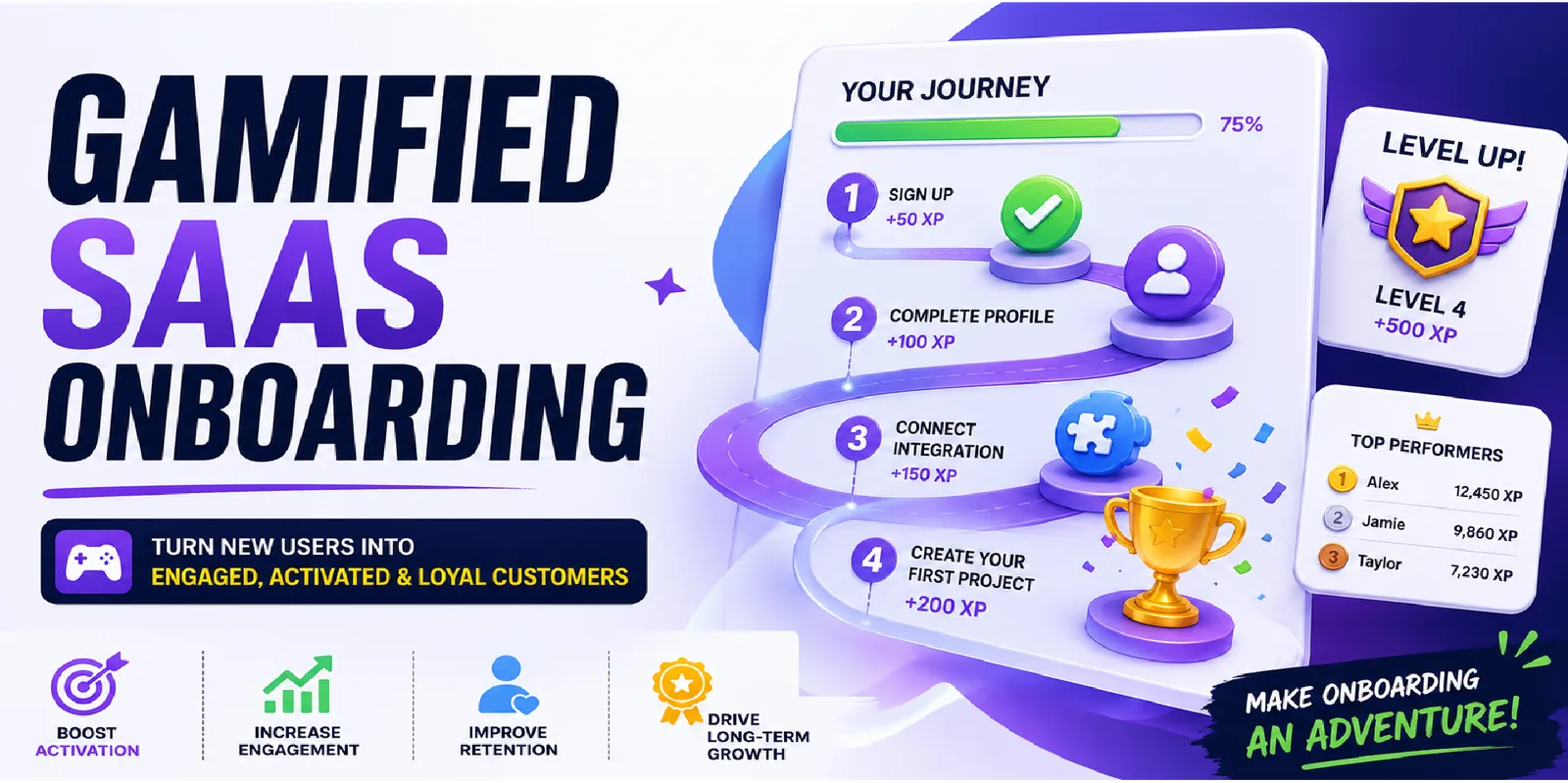
Gamified SaaS Onboarding
The implementation guide. Why gamified onboarding works (the boring research-backed part), the four mechanics that move SaaS activation, and the five-phase plan for designing the quest.
Muhammad Zeeshan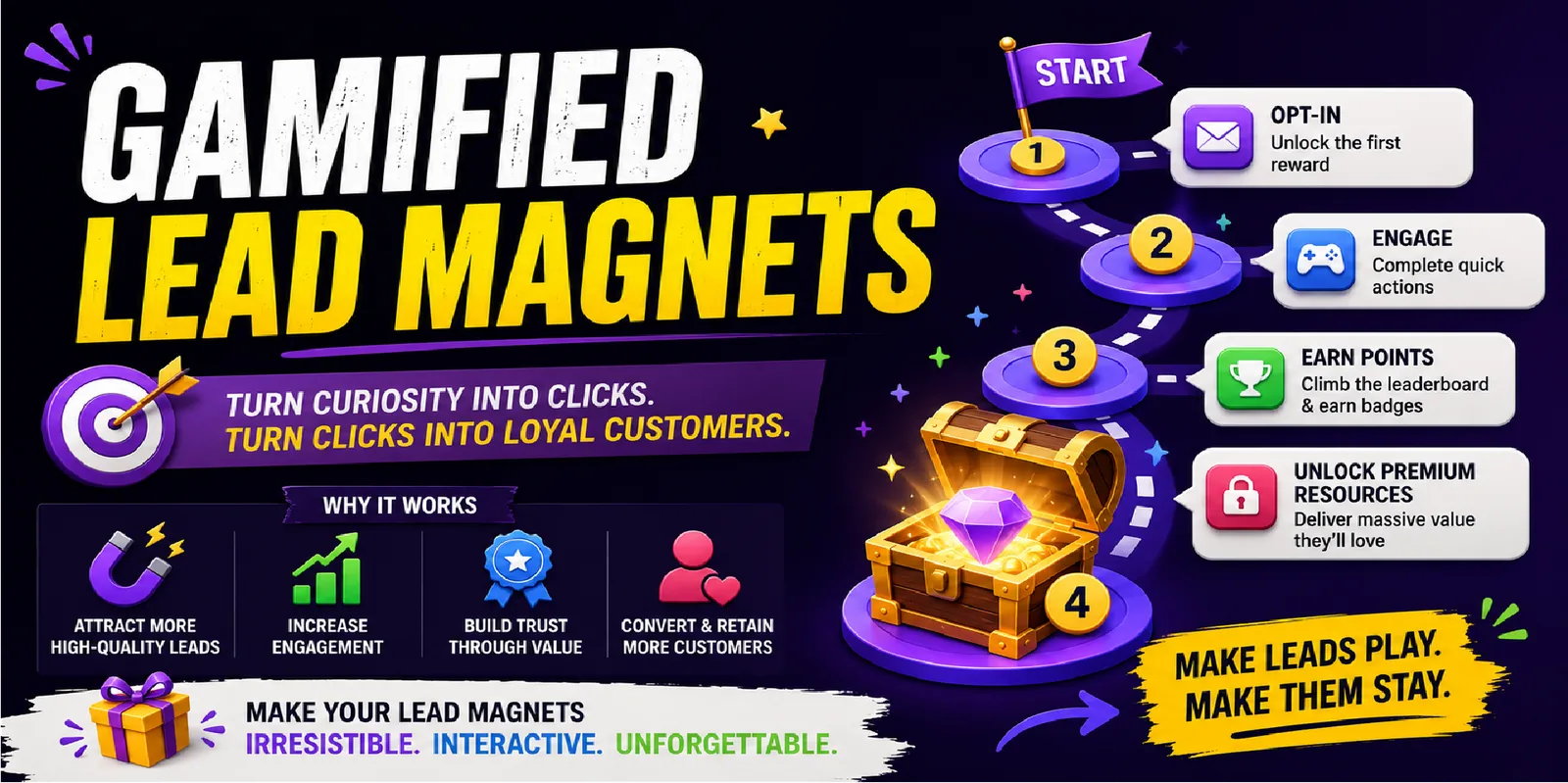
Gamified Lead Magnets
Static forms convert at 2 to 4 percent on cold traffic. Quizzes, spin wheels, and scratch reveals convert at 12 to 38 percent. The short, sharable version: when each mechanic wins, when it loses, and the reward economy that determines lead quality.
Muhammad Zeeshan
How Temu Used Gamification, Referral & Paid Ads to Explode in a New Market
How Temu grew with in-app games, referral rewards and heavy paid ads, what changed after US duty-free imports ended in May 2025, and what is still safe to copy.
Muhammad ZeeshanKeep exploring
From reading to doing.
See how we can help, look up a term, or check your own site with a free tool.
Put the guide to work.
Websites, Webflow, WordPress, Shopify, Framer, SEO, AEO and GEO, AI automation, and ongoing support.
See servicesPlain-language definitions.
SEO, AEO, GEO, website, and AI growth terms explained without the jargon.
Open the glossaryCheck and fix it yourself.
Free tools for SEO, AI search, and website planning, including an llms.txt generator and a schema builder.
Try the toolsReady when you are
Want help with Digital Marketing?
Send us your website and your goal. We will tell you honestly what should be done first, whether or not we work together.