

Norway’s IT Skills Gap: Why More Tech Leaders Are Turning to Flexible Talent Models
Norway’s digital economy is growing fast, but many companies are struggling with one thing they cannot easily buy: experienced IT professionals.

Norway’s digital economy is growing fast, but many companies are struggling with one thing they cannot easily buy: experienced IT professionals. A series of industry reports and employer surveys show that Norway is heading toward a significant shortfall in tech skills by 2030, especially in software development and IT security. For decision-makers in Oslo, Bergen, Trondheim or Stavanger, this is no longer an abstract forecast, it affects delivery timelines, product roadmaps and innovation capacity today.
In this article, we look at what the numbers say, how Norwegian companies are adapting with flexible talent models (often called IT staff augmentation or “fleksibel bemanning” / hiring external IT consultants), and what to consider if you are exploring this route.
What the Data Says About Norway’s IT Talent Shortage
Multiple Norwegian and Nordic sources point in the same direction: there are more IT roles than qualified people to fill them.
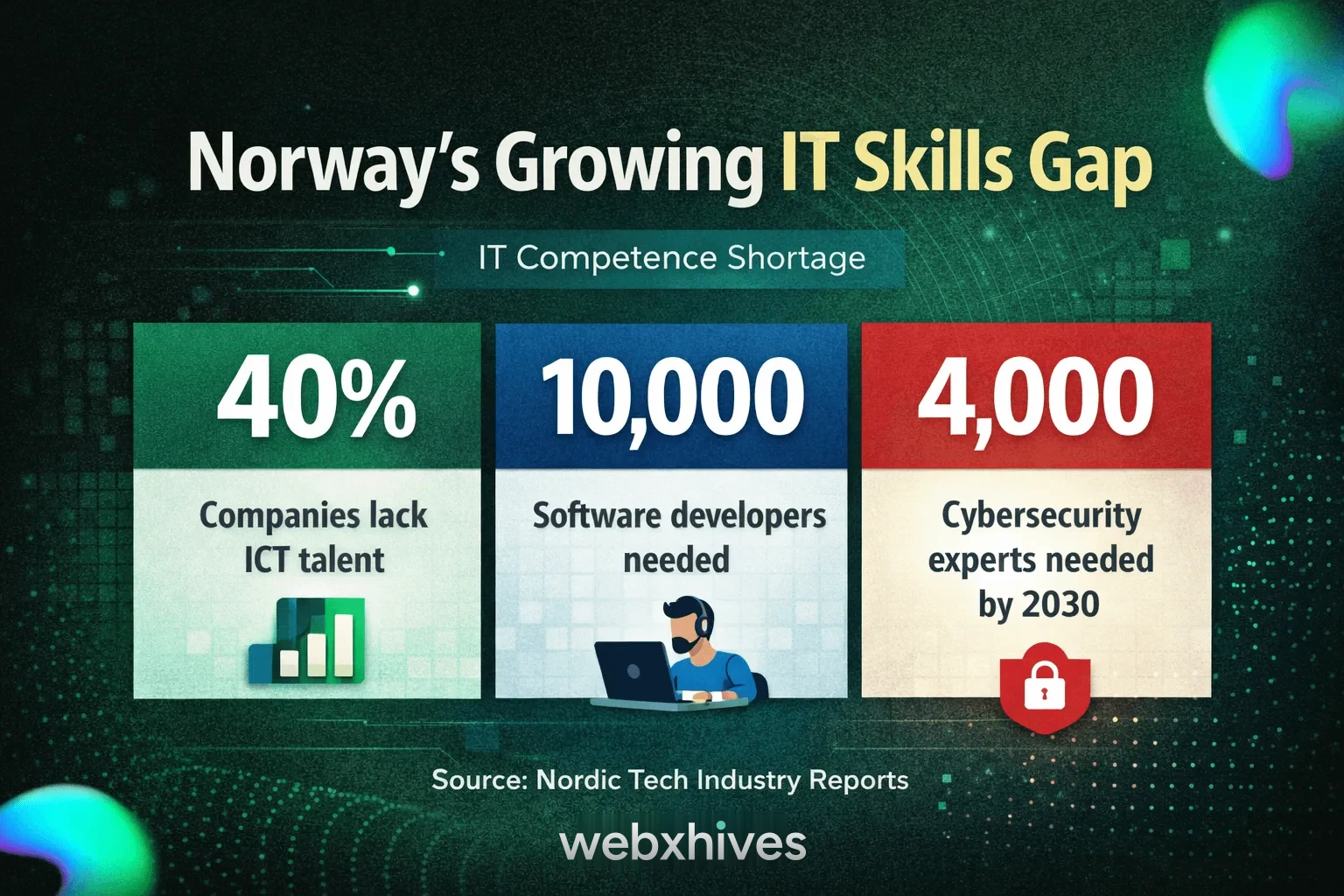
- ICT-Norway (IKT-Norge) and NHO report that around 40% of member companies already have partly or largely unmet needs for ICT competence.
- Nordic tech industry analysis suggests Norway faces a shortage of around 10,000 software developers in the coming years, on top of a projected shortfall of more than 4,000 IT security specialists by 2030.
- OECD work on Norway’s digital future highlights data-related skills as a critical bottleneck for further digitalisation and productivity improvements.
For many leaders, the pattern is familiar: roles stay open for months, recruitment costs rise, and teams compensate by stretching existing developers thinner.
The Cost Side: Hiring Developers in a High-Cost Market
Norway is consistently ranked as a high-cost labour market, and software developer salaries reflect this reality. Recent salary data indicates:
- A typical software developer in Norway earns between about 750,000 and 1,050,000 NOK per year, with senior and lead engineers often reaching 950,000 to 1,300,000 NOK.
- Other datasets suggest an average software developer salary around 553,828 NOK per year, with total compensation increasing with experience.
Beyond base salary, employers also carry:
- Social costs and benefits.
- Time spent sourcing, interviewing and onboarding.
- Risk that a hire does not work out or leaves after a short period.
For small and mid-sized companies, or teams outside the biggest hubs, competing head-to-head for the same pool of senior developers can be especially challenging.
How Norwegian Companies Are Responding
To keep roadmaps on track, more organisations are mixing permanent hiring with external capacity. Common patterns include:
- Using Norwegian IT consultancies to bring in specialists for short- or medium-term projects.
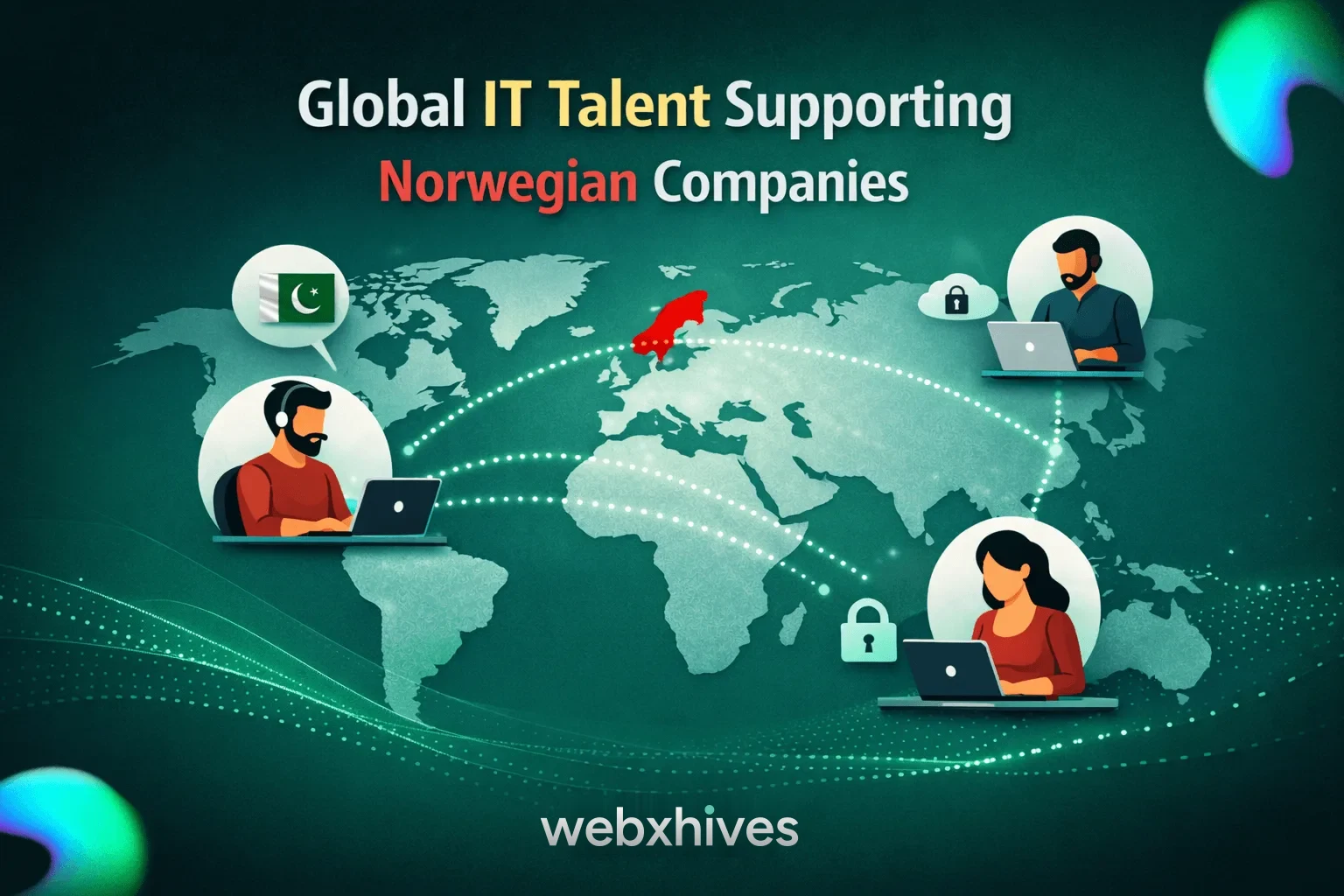
- Working with nearshore or global partners to add capacity in specific areas like cloud, DevOps, data engineering or cybersecurity.
- Combining in-house product ownership with distributed implementation teams to balance control and cost.
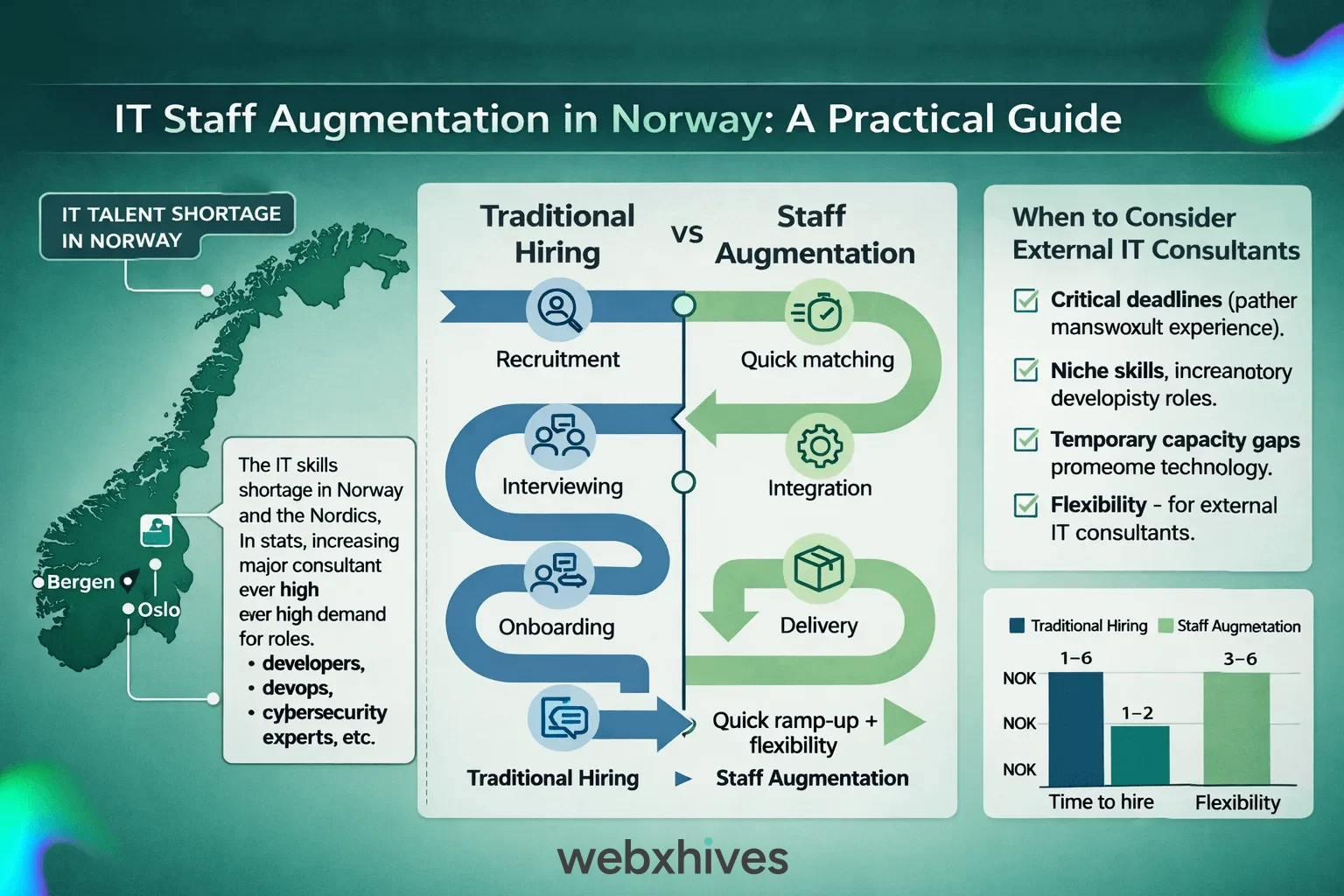
A widely used term internationally is IT staff augmentation, adding external professionals into your existing team for a defined period, while you keep control over the product, backlog and day-to-day priorities. In Norwegian conversations, this often appears simply as hiring eksterne IT-konsulenter or fleksibel bemanning for IT projects.
IT Staff Augmentation vs Traditional Hiring
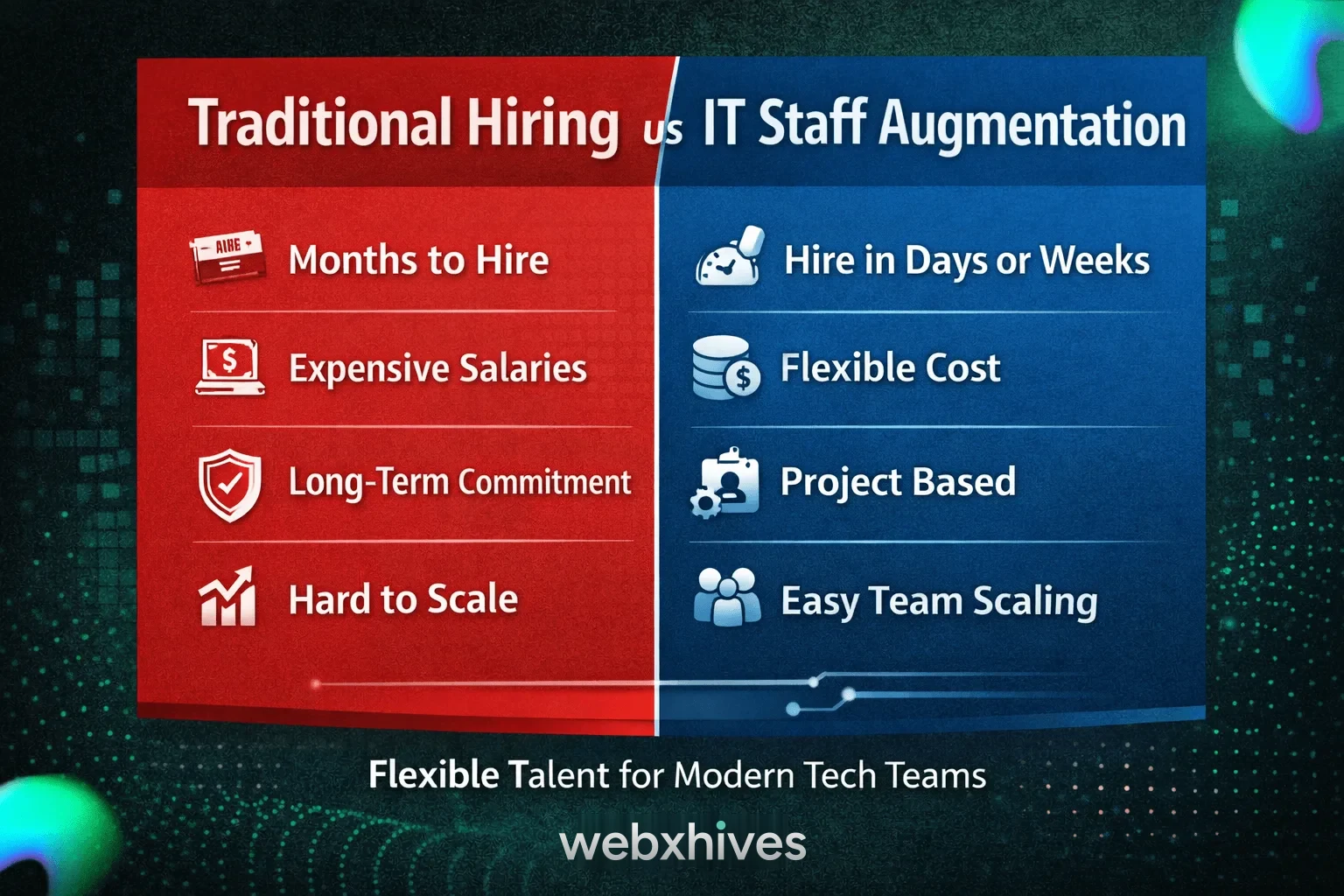
Both permanent hiring and staff augmentation have a place. The question for decision-makers is usually: “For this initiative, what is the most practical way to secure the skills we need?”
Below is a simplified comparison based on common industry patterns and Norwegian salary benchmarks:
For many Norwegian companies, the conclusion is not “either/or” but “both/and”: build a strong internal core, and supplement it with external capacity when needed.
When Does an External IT Team Make Sense?
Based on how Norwegian and Nordic companies are using flexible models today, external developers or consultants are often considered when:
- You have a clear product roadmap but not enough developers to deliver at the desired speed.
- You need specialised skills (e.g., cloud migrations, data platforms, AI/ML, cybersecurity) that are hard to hire for permanently.
- The work is substantial enough to justify onboarding someone external, industry practitioners often mention at least several man-months of work for staff augmentation to be a good fit.
- You want to avoid slowing down existing teams with endless context-switching.
In these scenarios, external capacity is less about “cheap labour” and more about reducing delivery risk and keeping commitments to customers and stakeholders.
What to Look For in a Staff Augmentation Partner
If you are exploring IT staff augmentation / external IT consultants as an option, there are a few practical criteria that leaders in Norway and the wider Nordics often focus on:
- Skills match: Does the partner have real experience in the technologies and domains you use (for example, your cloud provider, your data stack, your frameworks)?
- Way of working: Can external developers work inside your backlog tools (Jira, Azure DevOps, Trello, etc.) and follow your sprint or Kanban processes?
- Communication and culture fit: Clear English, overlap in working hours, and a structured, low-drama communication style tend to matter to Norwegian teams.
- Legal and data protection: For any work touching customer data or sensitive systems, GDPR compliance and clear data handling processes are essential.
- Transparency: Clear visibility into who is on your team, how time is used, and how knowledge is documented and handed over.
A well-structured staff augmentation model should make it easy to stop, extend or adjust the collaboration based on project needs, without lock-in
How Webxhives Fits Into This Picture
Webxhives offers staff augmentation for web design, development and SEO work: Webflow, WordPress and Shopify developers, UI/UX designers, SEO specialists and social media designers who work inside your existing team. It does not cover every IT role in this article, such as cloud, data engineering or security specialists. From a practical perspective, this means:
- Extra capacity for website builds, CMS work, ecommerce and SEO without a permanent hire.
- People who work inside your backlog and tools, rather than running projects separately.
- Scope you can extend, adjust or stop as project needs change.
You can read more about the roles available on the dedicated page:
Webxhives staff augmentation
Questions to Ask Before You Decide
Whether you work with Webxhives or another provider, a short internal checklist can help clarify if staff augmentation is right for your situation:
- Which projects or products are currently slowed down by lack of capacity?
- Which skills are hardest to hire or retain in-house today?
- How long do you realistically need extra hands, weeks, months, a year?
- Do you have a clear owner internally who can onboard and guide external developers?
If you can answer these questions concretely, you are in a good position to evaluate whether adding external developers alongside your Norwegian team will help you move faster with less risk.
For the web design, development and SEO roles Webxhives can support, see:
Webxhives staff augmentation
Key takeaways
- What the Data Says About Norway’s IT Talent Shortage
- The Cost Side: Hiring Developers in a High-Cost Market
- How Norwegian Companies Are Responding
- IT Staff Augmentation vs Traditional Hiring
Questions people ask about this
Short answers to the questions that come up most on this topic.
- Based on how Norwegian and Nordic companies are using flexible models today, external developers or consultants are often considered when:
Keep reading
Related articles.
More on the same thread, picked by tag and category, not chronology.
AI Video Labeling Rules in 2026
Europe's transparency rules and California's provenance rules both became enforceable on 2 August 2026. What applies in the EU, US, UAE and Pakistan, which videos actually attract penalties, and what it means for agencies and the companies that hire them.
Muhammad Zeeshan
How to Choose an AEO Agency
The buyer's side of answer engine optimization: the four layers a real program covers, twelve questions with the answers that should worry you, what it costs, and the cases where hiring anyone is the wrong move.
Muhammad Zeeshan
How to Choose an AEO Tool
Every AEO tool runs the same mechanic: a sampled prompt list against a few engines. Here is what they actually measure, the sampling problem nobody prices honestly, and the free cycle to run before you subscribe.
Muhammad ZeeshanKeep exploring
From reading to doing.
See how we can help, look up a term, or check your own site with a free tool.
Put the guide to work.
Websites, Webflow, WordPress, Shopify, Framer, SEO, AEO and GEO, AI automation, and ongoing support.
See servicesPlain-language definitions.
SEO, AEO, GEO, website, and AI growth terms explained without the jargon.
Open the glossaryCheck and fix it yourself.
Free tools for SEO, AI search, and website planning, including an llms.txt generator and a schema builder.
Try the toolsReady when you are
Want help with Staff Augmentation?
Send us your website and your goal. We will tell you honestly what should be done first, whether or not we work together.