

The 19 Best MCP Servers in 2026 (Ranked by Category)
Model Context Protocol servers are the connective tissue of the 2026 AI agent economy. The 19 best MCP servers across code, communication, CRM, databases, payments, design, observability, search, and browser automation, ranked by category.

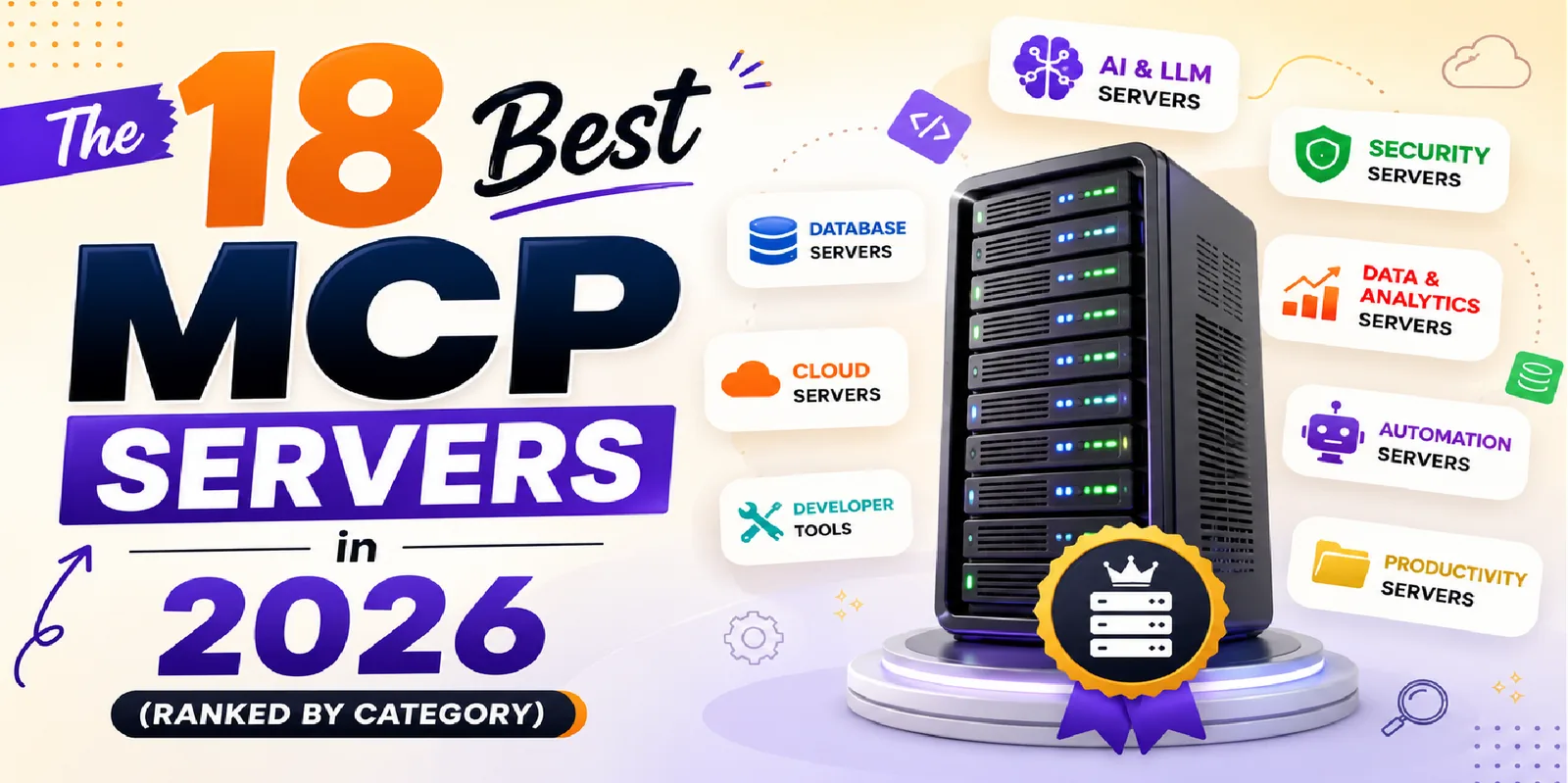
Model Context Protocol (MCP) servers are the connective tissue of the 2026 AI agent economy. Anthropic released the open standard in late 2024 and donated it to the Linux Foundation's Agentic AI Foundation in December 2025. By 2026 the major AI clients (Claude, ChatGPT, Cursor, Devin Desktop, VS Code, Zed, Cline) and most production agent frameworks (LangChain, CrewAI, Microsoft Agent Framework, OpenClaw) speak it natively. This guide lists the best MCP servers worth integrating into your AI agent stack right now, ranked by category. We focus on production-grade servers, not the long tail of toy demos.
What an MCP server does
A Model Context Protocol server exposes a set of tools (functions an agent can call) and resources (data an agent can read) over a standard JSON-RPC interface. Any MCP-aware AI agent can discover the server's capabilities, call its tools, and consume its resources without bespoke API integration code. One server, dozens of compatible agents.
The practical impact: instead of writing a custom OpenAI function-calling integration for each external service, you write the integration once as an MCP server and every agent in your stack can use it. Your agents become tool-rich in a fraction of the engineering time.
The other practical impact: you can publish your own services as MCP endpoints and let other agents call them. Any MCP client that supports remote servers can connect to a hosted endpoint.
The 19 best MCP servers in 2026
Ranked by category. Each entry includes the publisher, what the server exposes, where it shines, and whether to self-host or use the hosted version.
Code and version control
1. GitHub MCP Server
Publisher: GitHub (official). Exposes: repos, issues, PRs, code search, GitHub Actions, releases. Read and write. Use case: coding agents pull issues, write branches, open PRs, and respond to review comments without leaving the agent loop. Self-host or hosted: GitHub hosts a remote endpoint; teams on GitHub Enterprise Server run the local server instead.
2. GitLab MCP Server
Publisher: GitLab (official).
Exposes: merge requests, work items, repository, CI pipelines, wikis.
Use case: drop-in for teams on GitLab. Same agent code, different MCP endpoint.
Self-host or hosted: built into GitLab (beta) on GitLab.com, Self-Managed, and Dedicated, at your instance's /api/v4/mcp endpoint.
3. Linear MCP Server
Publisher: Linear (official). Exposes: issues, projects, cycles, comments, status updates. Use case: ops agents that triage Linear tickets, status-update meetings, and write follow-ups. Pairs cleanly with the GitHub server for full dev-loop automation. Self-host or hosted: Linear hosts it.
Communication and collaboration
4. Slack MCP Server
Publisher: Slack (official, announced 17 February 2026). The old Anthropic reference server is archived.
Exposes: channels, messages, threads, search, file uploads.
Use case: standup-reporter agents, support-triage agents, and on-call-incident agents all rely on it.
Self-host or hosted: Slack hosts it at mcp.slack.com/mcp.
5. Discord MCP Server
Publisher: community-maintained (several open-source servers wrap Discord's bot API). Exposes: channels, messages, threads, user lookup, role management. Use case: community-management agents, support-deflection agents in Discord-first product communities. Self-host or hosted: self-host.
6. Gmail and Google Workspace MCP Server
Publisher: Google (official, Developer Preview as of September 2026). Exposes: Gmail (search, read, draft, and label; it cannot send), Google Calendar (read, write events), Google Drive (file search and read). Use case: executive-assistant agents that triage inbox, schedule meetings, and fetch deck links. Self-host or hosted: Google hosts it.
CRM and sales
7. HubSpot MCP Server
Publisher: HubSpot (official, generally available since 13 April 2026). Exposes: contacts, companies, deals, tickets, notes, properties, lists. Use case: sales-agent stack. Lead enrichment, deal updates, follow-up scheduling, pipeline hygiene. Self-host or hosted: HubSpot hosts it.
8. Salesforce MCP Server
Publisher: Salesforce (official Hosted MCP Servers, generally available since April 2026). Exposes: accounts, opportunities, leads, contacts, custom objects, SOQL queries. Use case: enterprise sales-agent stacks where HubSpot is not the CRM. Heavier setup than HubSpot's MCP but equally complete coverage. Self-host or hosted: Salesforce hosts the official one.
9. Attio MCP Server
Publisher: Attio (official). Exposes: the customizable Attio data model: records, lists, notes, tasks, comments, and meeting and email search. Use case: modern sales agents at startups using Attio instead of HubSpot or Salesforce. The data model flexibility is a real differentiator for non-standard CRM shapes. Self-host or hosted: Attio hosts it.
Databases and data warehouses
10. Postgres MCP Server
Publisher: the Anthropic reference server is archived and has a published read-only bypass. Use a maintained server instead, such as Google's open-source MCP Toolbox for Databases or your Postgres provider's own server. Exposes: SQL queries (read-only by default), schema introspection, table listings. Use case: analytics agents that answer business questions by querying production or replica databases. Self-host or hosted: always self-host. The server needs database credentials and should run inside your network.
11. BigQuery MCP Server
Publisher: Google (official, generally available since 20 April 2026). Exposes: dataset listing, table schema, query execution, query results. Use case: data-team agents that run analytics on Google's warehouse. Pairs with the Postgres server for hybrid OLTP plus OLAP coverage. Self-host or hosted: Google hosts it; self-hosted wrappers exist for private VPC setups.
12. Snowflake MCP Server
Publisher: Snowflake (official Snowflake-managed MCP server). Exposes: databases, schemas, tables, query execution. Use case: same as BigQuery but for Snowflake-native shops. Self-host or hosted: Snowflake hosts it.
Payments and finance
13. Stripe MCP Server
Publisher: Stripe (official, hosted at mcp.stripe.com).
Exposes: customers, subscriptions, invoices, payment intents, and refunds. When an agent acts with your login, Stripe asks a person to confirm refunds. From 31 October 2026 the server accepts only OAuth or Agent-tagged API keys.
Use case: the canonical example everyone cites when explaining MCP. Customer-success agents resolve billing tickets by looking up subscription state. Finance agents automate dunning workflows.
Self-host or hosted: Stripe hosts it.
Design and product
14. ImagineArt MCP Server
Publisher: ImagineArt (official). Exposes: text-to-image, text-to-video, background removal, image upscaling, and music generation. Use case: creative-production agents that generate campaign visuals and short-form video without leaving the agent loop. The ImagineArt MCP authenticates through your existing imagine.art account, so there are no API keys to manage. Self-host or hosted: ImagineArt hosts it.
15. Figma MCP Server
Publisher: Figma (official). Exposes: design context (frames, components, variables, layout), code generation from frames, Code Connect mappings, and writing native content back to the canvas. Use case: design-handoff agents, design-spec readers, brand-guideline checkers. Pairs with the GitHub server to close the design-to-code loop. Self-host or hosted: Figma hosts it.
Observability and ops
16. Sentry MCP Server
Publisher: Sentry (official). Exposes: events, issues, traces, releases, alerts. Use case: incident-response agents that triage Sentry errors, link them to GitHub PRs that introduced regressions, and post root-cause analyses to Slack. Pairs with the GitHub plus Slack plus Linear servers for closed-loop incident response. Self-host or hosted: Sentry hosts it.
17. Cloudflare MCP Server
Publisher: Cloudflare (official). Exposes: Workers, R2, KV, DNS, page rules, analytics. Use case: infrastructure-ops agents that diagnose performance regressions, rotate API tokens, and push edge-rule updates. Stronger than most cloud-provider MCP servers because Cloudflare's API surface is unusually clean. Self-host or hosted: Cloudflare hosts it.
Web search and content
18. Brave Search MCP Server
Publisher: Brave (official). Exposes: web search, news search, image search. Use case: research agents and current-events agents. Self-host or hosted: self-host. You run Brave's open-source server locally or behind your own HTTP endpoint, with a Brave Search API key.
Browser automation
19. Playwright MCP Server
Publisher: Microsoft (official, open source). Exposes: browser navigation, clicks, form input, tab management, and structured accessibility snapshots of the page, so the model works from page structure instead of screenshots. Use case: agents that need to work in web apps with no API: filling forms, checking a checkout flow, collecting data from a dashboard, or testing a release. Self-host or hosted: self-host. It runs locally next to the agent and drives a real browser on your machine or server.
How to pick which MCP servers to install
Start with these four every modern agent stack needs:
- GitHub for code interaction (or GitLab if you are on GitLab).
- Slack or Discord for the human notification layer.
- Postgres or your data warehouse server (BigQuery, Snowflake) for analytics.
- Brave Search for current-events grounding.
Then layer in the verticals that match your workflow:
- Sales agents add HubSpot, Salesforce, or Attio.
- Support agents add Stripe (for billing context) plus Linear or Zendesk.
- Ops agents add Sentry, Cloudflare, and Gmail.
- Design-eng loop agents add Figma plus the GitHub server you already have.
Count tools, not servers: one server can expose dozens of tools. Anthropic reports that tool selection degrades once an agent sees more than 30 to 50 tools, and OpenAI suggests fewer than 20 functions per turn. Past that, load tools on demand with tool search or split the work across smaller agents.
How to host your own MCP server
The MCP spec (modelcontextprotocol.io) defines two transports: stdio (process-to-process, used by desktop agents like Claude Desktop and Cursor) and streamable HTTP (network-callable, used by hosted endpoints). The current revision, dated 2026-07-28, makes the protocol stateless: there is no initialize handshake or session ID, and every request carries its own protocol version and capabilities.
For production, self-host the streamable-HTTP variant on Cloudflare Workers, AWS Lambda, or any Node.js runtime. The official TypeScript SDK (@modelcontextprotocol/server, v2) implements the 2026-07-28 revision. A minimal MCP server with three tools is roughly 80 lines of TypeScript.
A common setup is a Cloudflare Worker that answers JSON-RPC at a /mcp path. The same shape works for any internal tool you want to expose to your agents.
Want this built for you?
Webxhives builds AI agents that connect to the tools your team already uses, including through MCP servers like the ones above, and tests them on real examples before rollout. Use the contact page to scope a project.
Key takeaways
- MCP collapses bespoke API integration into one discoverable contract. Write once, every MCP-aware agent can call it.
- Self-host servers that touch your own databases; for SaaS tools, use the vendor's hosted server with narrow OAuth scopes.
- Most major vendors now host their own MCP server, including Stripe, HubSpot, Slack, Figma, and Sentry.
- Count tools, not servers: one server can expose dozens of tools. Anthropic reports that tool selection degrades once an agent sees more than 30 to 50 tools, and OpenAI suggests fewer than 20 functions per turn. Past that, load tools on demand with tool search or split the work across smaller agents.
- Publishing your own MCP server is roughly 80 lines of TypeScript with the official SDK.
Questions people ask about this
Short answers to the questions that come up most on this topic.
- MCP (Model Context Protocol) servers use an open standard, created by Anthropic and now governed by the Agentic AI Foundation, to expose tools and data to AI agents over JSON-RPC. They matter because they collapse what used to require bespoke API integration code into a discoverable, agent-callable contract. One MCP server works with Claude, ChatGPT, OpenClaw, LangChain, CrewAI, Microsoft Agent Framework, Cursor, Devin Desktop, Zed, and Cline.
- Native MCP support: Claude (apps, Claude Code, and the API), ChatGPT (plugins built on MCP, plus developer mode for custom servers), Cursor, Devin Desktop (formerly Windsurf), VS Code, Zed, Cline, OpenClaw, LangChain (built in through `langchain[mcp]`), CrewAI, Microsoft Agent Framework, and the OpenAI Agents SDK. The protocol effectively became the default standard through 2025.
- As safe as you scope them. Most MCP servers support OAuth or token-based auth with scope restrictions. Best practice: dedicated MCP server token per agent with narrowest possible scope, log every tool call, security-review any community-maintained server before installing.
- Use the vendor's hosted server when one exists: Stripe, HubSpot, Slack, Linear, Sentry, and Figma host theirs, and you control access with OAuth scopes and agent-specific keys. Self-host servers that connect straight to your own systems, such as a database, and run GitHub's local server on GitHub Enterprise Server.
- Count tools, not servers: one server can expose dozens of tools. Anthropic reports that tool selection degrades once an agent sees more than 30 to 50 tools, and OpenAI suggests fewer than 20 functions per turn. Past that, load tools on demand with tool search or split the work across smaller agents.
- Yes. Pick the streamable HTTP transport, define your tools with the reference SDK, deploy to any Node-compatible runtime, and announce the endpoint URL. To get found, publish it to the official MCP Registry and to each client's directory. There is no standard `.well-known` discovery file yet; the Server Cards proposal is still in review.
- For agent-to-service integrations, mostly yes. For service-to-service or human-to-service interactions, REST keeps its place. MCP is a layer on top of REST optimized for AI agent discoverability. Many MCP servers in 2026 are thin wrappers around existing REST APIs that publish the JSON schema in a form LLMs can reason about.
- Yes. The agents we build can call external MCP servers for tool access and can expose their own skills as MCP endpoints when other agents need to call them. See the AI agents service page for how a build works.
Keep reading
Related articles.
More on the same thread, picked by tag and category, not chronology.
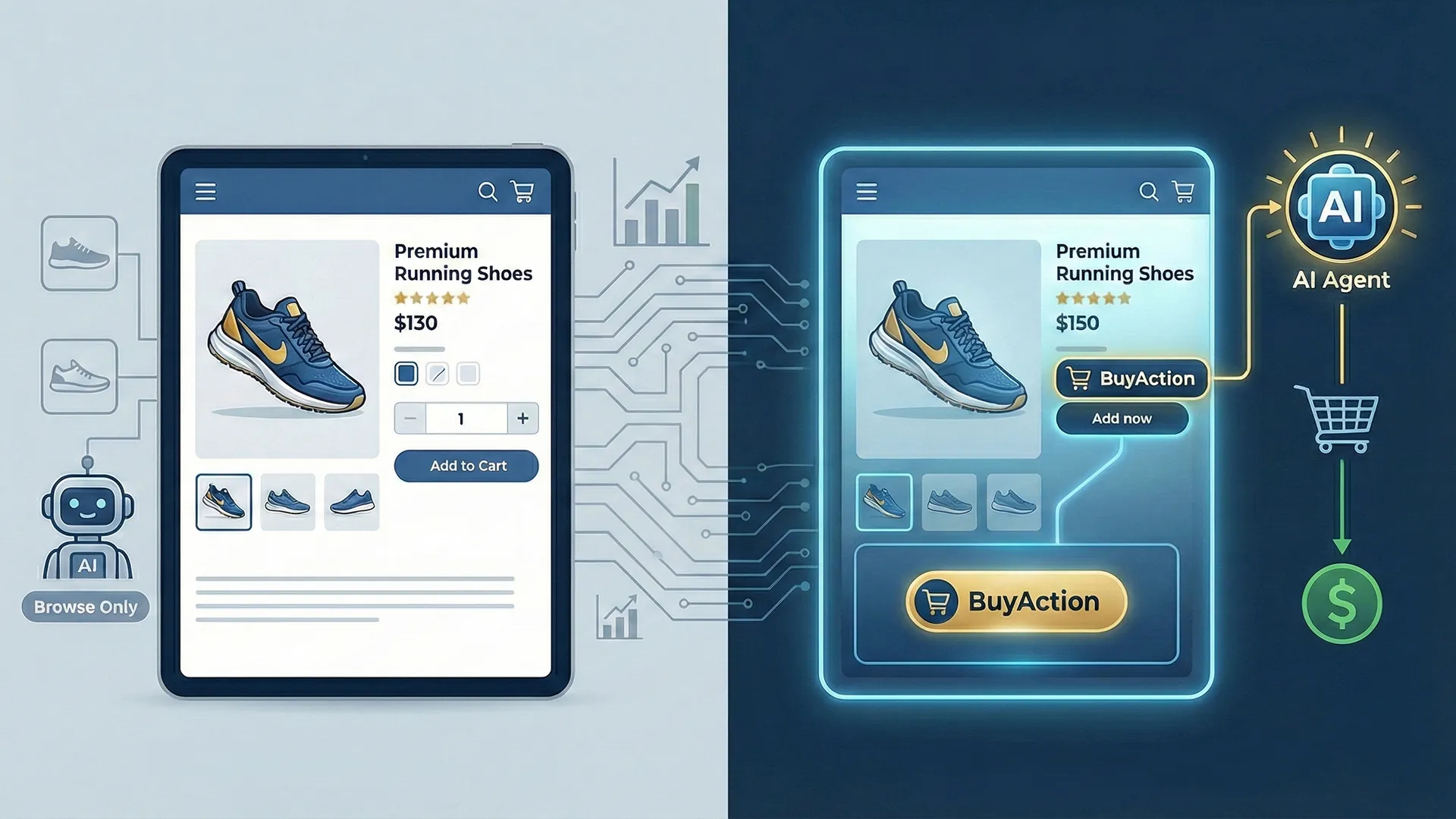
Action Schema: Implementing Potential Action for AI Agents
Where Schema.org BuyAction and potentialAction fit beside the protocols AI shopping agents use in 2026: Google's UCP, OpenAI's ACP and WebMCP.
Muhammad Zeeshan
What Are AI Agents? A Business Leader's Guide for 2026
AI agents are autonomous software systems that perceive, reason, and act to complete business tasks. Learn what they are, how they work, and why they matter in 2026.
Muhammad Zeeshan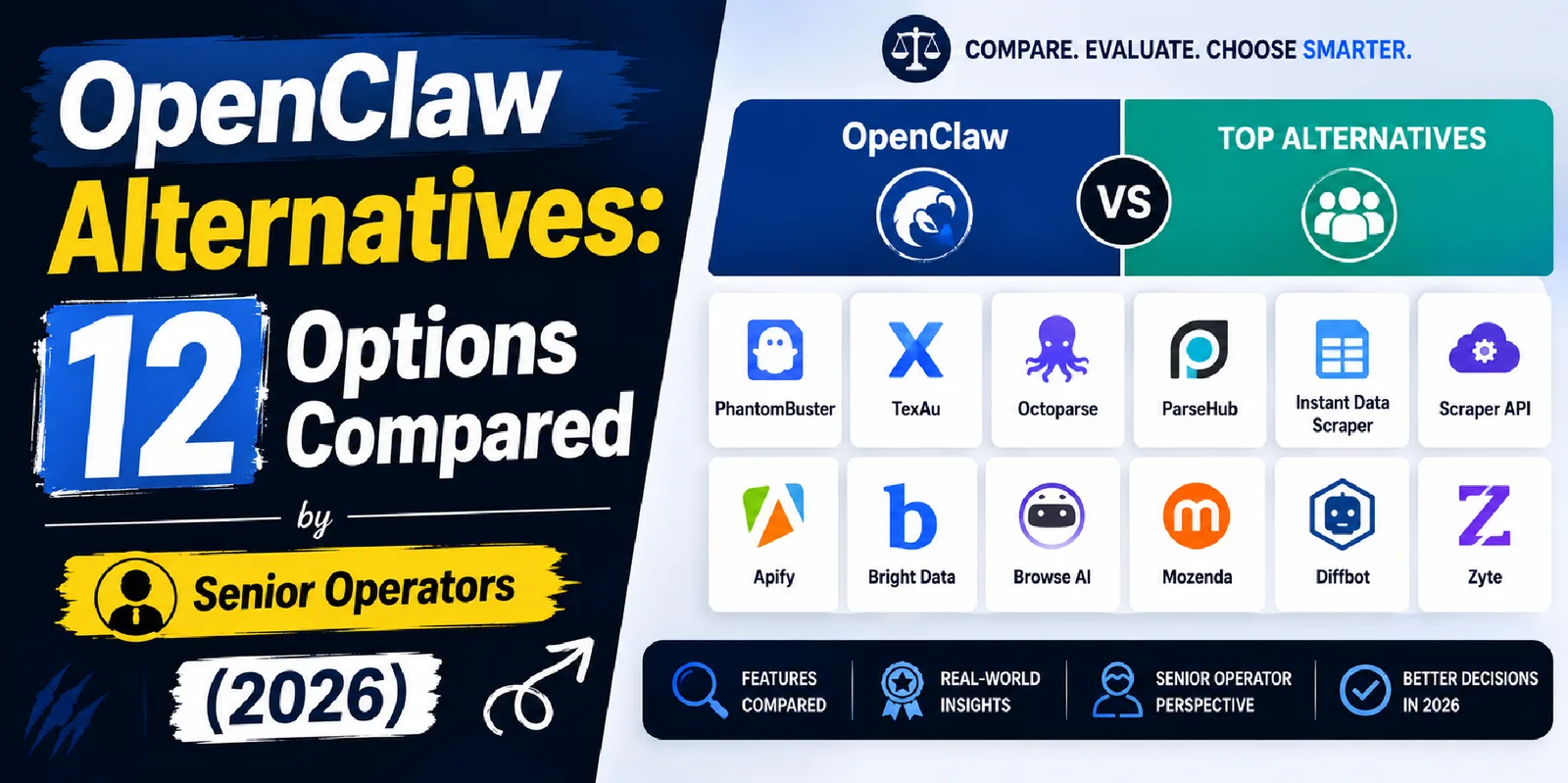
OpenClaw Alternatives: 12 Compared
An honest comparison of 12 OpenClaw alternatives across code-first runtimes and open-source agents (LangChain, CrewAI, Microsoft Agent Framework, Hermes Agent), visual workflow tools (n8n, Zapier, Make, Lindy), and hosted agent products (Vellum, AgentGPT, AutoGPT).
Muhammad ZeeshanKeep exploring
From reading to doing.
See how we can help, look up a term, or check your own site with a free tool.
Put the guide to work.
Websites, Webflow, WordPress, Shopify, Framer, SEO, AEO and GEO, AI automation, and ongoing support.
See servicesPlain-language definitions.
SEO, AEO, GEO, website, and AI growth terms explained without the jargon.
Open the glossaryCheck and fix it yourself.
Free tools for SEO, AI search, and website planning, including an llms.txt generator and a schema builder.
Try the toolsReady when you are
Want help with AI Agents?
Send us your website and your goal. We will tell you honestly what should be done first, whether or not we work together.